Wednesday, April 4, 2012

Yutyrannus: The Feathered Overlord

It's finally happened. We've found our first large-bodied Feathered Dinosaur!

In what is almost undoubtedly the biggest dinosaur discovery of the year, I'm very pleased to introduce you all to the world's largest known feathered animal; the 3,000-pound, 30 foot long tyrant Yutyrannus huali. A smaller cousin of the fearsome T-rex, Yutyrannus lived roughly 125mya alongside the rest of the feathered Yixian dinosaurs, including the previous record-holder Beipiaosaurus inexpectus. It's going to take a seriously good discovery this year to top this one, which us dinosaur nerds are always hoping for anyways!

This is just paleontological gold, at first I didn't even believe something like this could be real. I thought it might be some kind of late April Fools day joke the scientists made up, but then I actually saw some images of the specimens, and you can clearly make out long, filament-like feathers on them! Apparently, their were three specimens recovered, two adults and a juvenile, and all three have feather impressions on them!

What exactly was Yutyrannus using it's feathers for? Certainly not flight, but perhaps instead they were used as a type of display like a peacock, or possibly for insulation. Why would a 30 foot long 1.5 ton animal need insulation? Typically, the larger an animal is the more stable it's body temperature, thus they don't need much very much insulation because their is otherwise a risk of overheating. However, during the time Yutyrannus was living, the environment of the Yixian formation was actually really, really cold.

Typically when we think of the Mesozoic, we imagine it as being a hot, steaming, swamp-like environment. However, it seems that during the Early Cretaceous period, the planet might have been experiencing a small ice-age. Some scientists have found evidence of glaciation, cold seas, and large expansions of temperate forests around the world. Even evidence for an average temperature of roughly 10 degrees Celsius has been proposed for places like Liaoning. Maybe Yutyrannus evolved its thick coat in order to survive this cold environment, rather like the extinct Mammoths that roamed across the northern hemisphere during the last glacial period.

Now with the discovery of Yutyrannus it begs the question, were later tyrannosaurs also fluffy? During the late Cretaceous when T-rex and many of its relatives lived, the climate was very warm, with snow restricted to the far north and no known glaciers present. Some may argue that this might indicate that while the cold-weather Yutyrannus needed feathers, T-rex would've lost them in it's warmer environment. However, modern day birds have been known to use their feathers both to warm and cool themselves. For example, Ostriches have been known to use their feathers to help both warm and cool their bodies by directing airflow over their feather-less areas, like the thighs. Thus, it's certainly possible that the later tyrannosaurs could have also retained some feathers on the body for cooling purposes.

I know I could probably say a lot more, but I think I'll save that for another topic. As always, feel free to speak your mind, I'm perfectly happy to take requests for topics, and make sure to stay sharp!

Tuesday, April 3, 2012

It's a Huge Ornithomimus! It's a Giant Effigia! No, it's a Deltadromeus!

 
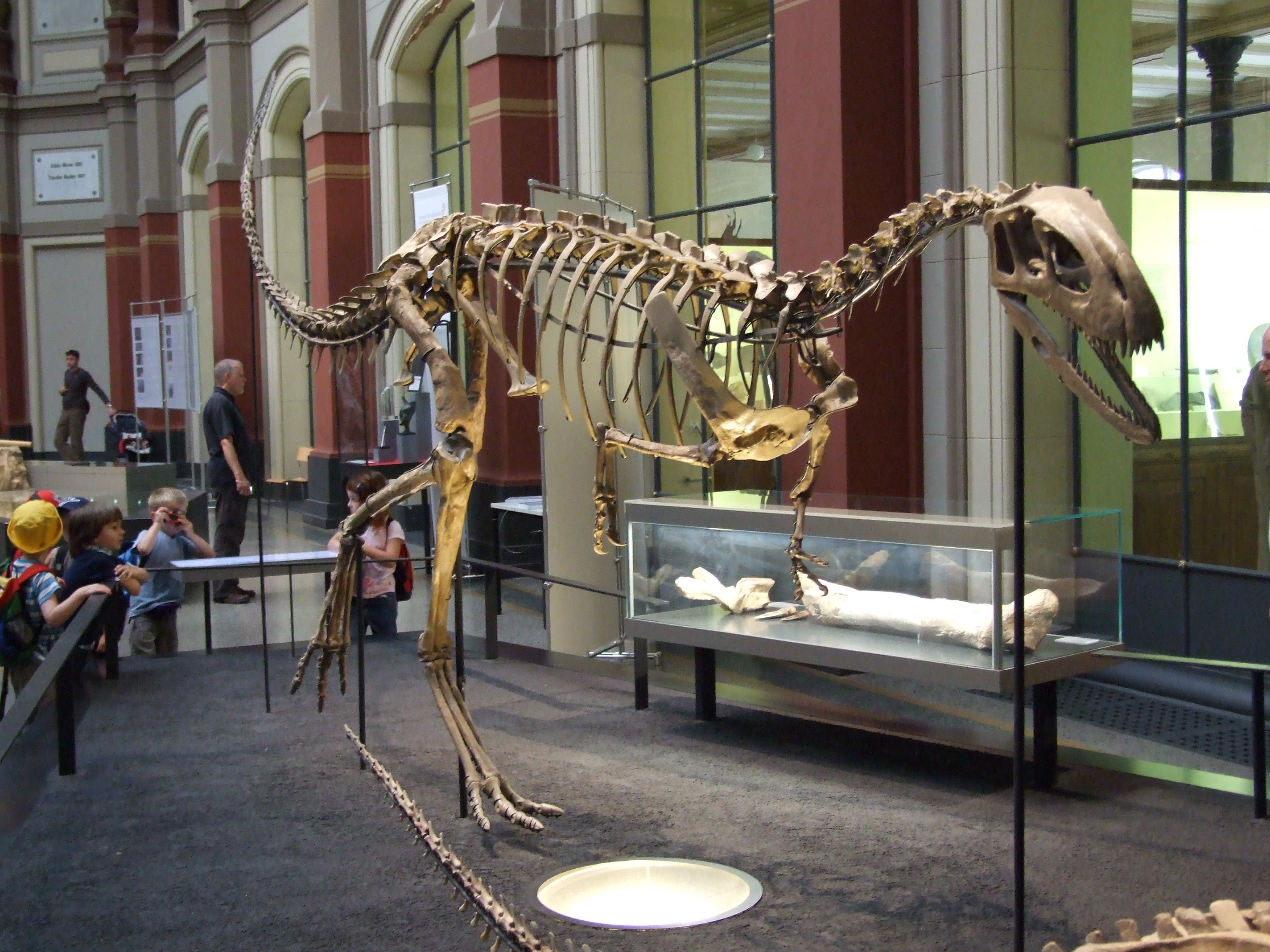
The typical look of Deltadromeus,
but is this what it really looked like?
Why are Saharan theropods always so fragmentary? We know that during the Mid-Cretaceous there were many species of theropods living throughout the Sahara, such at the abelosaurids Kryptops palaios and Rugops primus, the carcharodontosaurids Eocarcharia dinops and both species of Carcharodontosaurus, and of course most famously the giant spinosaurid Spinosaurus aegyptiacus but so little of their fossils are known that we're still having trouble making a clear picture of this long forgotten realm. In my opinion though, the most puzzling of theropods in the Sahara is most likely Deltadromeus.

Now I know what you're going to say; "Why Deltadromeus? For a Theropod it's not that weird. Why not those fin-backed Spinosaurs, or those short-faced Abelosaurids?" Well, that's what you probably think now, but you see, in the past few years some information on a bizarre group of dinosaurs has changed our perception on what we thought we knew about Deltadromeus, and suggests that this animal might actually be far different than what anyone expected.
_____________________________________________________________________________

Deltadromeus: The Predator You Know

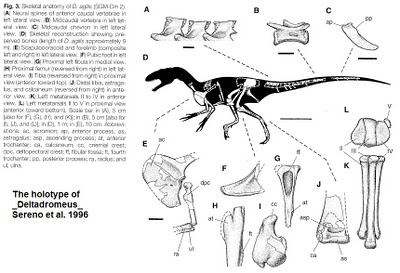
Deltadromeus agilis was named by Paul Sereno in 1996. It has been a mystery since its discovery, known only from two partial skeletons with elements of the legs, pelvis, tail, ribs, and bits of the arm bones. Sadly no elements of the skull or the hands of Deltadromeus have ever been found, leaving its business end completely unknown.

Known Elements of Deltadromeus
The holotype Deltadromeus specimen was first described as a mid-sized theropod, being around 26 feet long and very gracile. However, a second larger specimen of Deltadromeus suggests an animal that reached T-rex-sized proportions, meaning that it might have competed with the largest theropods known in the area, such as Carcharadontosaurus. In fact, some have suggested that the gigantic Bahariasaurus ingens might actually represent the same animal as Deltadromeus, but as so typical of Saharan Dinosaurs, it's impossible to tell at the moment since both creatures are very fragmentary. However, both of the original Deltadromeus specimens were thought to represent Bahariasaurus specimens, thus they very well might both be synonymous.

Deltadromeus was described by many as having unusually long legs. Deltadromeus has some of the longest legs of any large theropod, probably only beaten by advanced albertosaurids when comparing leg ratios. Having such long legs might have permitted Deltadromeus to hunt down faster game in the Sahara than Carcharadontosaurus. Another interesting feature is its shoulder girdle, which is massively constructed, suggesting powerful forelimbs.

For a long time Deltadromeus was considered a type of large coelurosaur due to some similarities and the fact that its proportions best matched small members of the group. However, more recent analyses have found it to instead represent a species of ceratosaur, although its exact placement remains unknown. A study in 2003 suggested that it was a very large member of the noasaurids, which were small-sized ceratosaurs like Noasaurus and Masiakasaurus. But more recent studies have instead come up with a different conclusion, and found Deltadromeus to be more closely linked to a strange group of Late Jurassic ceratosaurs, sometimes referred to as the Elaphrosauridae.
_____________________________________________________________________________

Elaphrosaurs: The Ceratosaurs You Didn't Know About

What's an elaphrosaur? Actually, I didn't know that answer myself until a few months ago, and being such odd dinosaurs you'd expect them to get much more attention for their quirkiness. Elaphrosaurs were a type of basal ceratosaur, but were very lightly built. They had long and powerful legs, a gracile build, robust shoulder girdles, and most members of the group are missing their skulls (sound familiar at all?). This family of dinosaurs is named after the mysterious Elaphrosaurus bambergi.

Elaphrosaurus lived in the Late Jurassic of Tanzania, and would've lived alongside other dinosaurs in the Jurassic, such as Giraffititan brancai, Kentrosaurus aethiopicus, and even possibly Allosaurus. A possible skeleton of Elaphrosaurus has also been found in the lower part of the Morrison Formation, but it awaits further study. The name Elaphrosaurus means "lightweight lizard," and if you were to see the skeleton, you'd know why.

Mounted Skeleton of Elaphrosaurus
Skull and limbs are speculative
Elaphrosaurus was about as gracile and lightweight as an Ostrich. Its tibia-to-femur ratio is also very large, suggesting it was very fast, perhaps even the fastest runner of the Jurassic. At abut 20 feet long, 4 feet tall at the hips, and a weight of about 450 pounds, this animal was clearly built for speed.

Elaphrosaurus was first discovered in 1920, but it wasn't until much later that we found our next member of this weird group. Known as Spinostropheus, it was actually first thought to represent a new species of Elaphrosaurus during the 1960s, but was given the name Spinostropheus in 2004. Living in Niger during the late Jurassic, it was going the same way as all the other Saharan theropods and is very fragmentary. Another possible candidate for an elaphrosaur includes the Early Jurassic Berberosaurus liassicus, however some scientists have since found this fragmentary animal to be more closely related to the dilophosaurs. Only time will tell if it is actually related to this odd group.
_____________________________________________________________________________

The Mystery is Solved by Limusaurus

In 2009, another species of elaphrosaur was revealed. Dubbed Limusaurus inextricabilis, it is the most complete elaphrosaur yet found. Limusaurus had the typical elaphrosaur-like body plan, but it was very small, only about 6 feet, making it among the smallest of theropods outside the mainiraptors, and possibly the smallest ceratosaur. Not just that, but Limusaurus was the first elaphrosaur found with a skull and arms intact! We now finally know what the skulls of these strange, lightweight predators looked like! Limusaurus, as it turns out, looked like this:

Wait.... that's a Ceratosaur?


Well, yes as this turns out to be the case, Limusaurus didn't look like any of its larger carnivorous kin, and more closely resembled the ornithomimids and small ornithopods in the later Cretaceous than the horned Ceratosaurus or the gigantic Majungasaurus. Yet, an analysis showed that it was indeed a type of ceratosaur, a bizarre offshoot of the group that evolved towards a different lifestyle -- one biased towards plants.

Their are multiple pieces of evidence suggesting that Limusaurus gave up the meat-filled diet of its relatives. It has a short, deep skull, a slender lower jaw with a downward-curved tip, small, vestigial forelimbs with only two functional digits (like tyrannosaurs), it's entirely toothless, and has a beak at the front of its jaws. This beak actually shares many traits in common with small ornithischian dinosaurs like Hypsilophodon. But the smoking gun for finding out that Limusaurus was a herbivore was the discovery of a patch of gastroliths in both of the known specimens. Gastroliths are used by herbivorous birds to help grind up plant matter within the bird's gut, and are also found in many other types of herbivorous dinosaurs. This all provides strong evidence that Limusaurus was an herbivore/omnivore that ate and digested plant matter.

With the discovery of Limusaurus, our idea of what
Elaphrosaurus looked like changed dramatically.
The discovery of Limusaurus has opened a window into the entire elaphrosaur family of dinosaurs. If Limusaurus was biased towards a herbivorous lifestyle with the discovery of its skull, what if other elaphrosaurs were as well? All other members of the family have their skulls unknown, so it is certainly possible that they were in fact an entire family of herbivorous ceratosaurs. In fact, it's interesting to note that Elaphrosaurus was first thought to represent a Jurassic ornithomimid, fueling the idea of herbivory in that species as well.

But wait!  If elaphrosaurs were herbivorous theropods, and recent studies have found that Deltadromeus might have an affinity with this group, then.....
_____________________________________________________________________________

What No One Expected

Yes, there is a possibility that Deltadromeus actually represents a type of herbivorous ceratosaur within the elaphrosauridae. You don't think so? Well I could hardly believe it either when I heard the idea myself, but it makes sense to me when I looked through the evidence for it.

Deltadromeus is only known from 2 partial skeletons, and only its legs, pelvis, parts of the tail, and a few bones from the forelimbs are known. We only knew about the same from Elaphrosaurus when it was first discovered, meaning that the really odd parts like the head and neck are still missing for Deltadromeus, and we still don't know what Deltadromeus' teeth looked like. (Some rock shops claim to sell Deltadromeus teeth, but the truth is that there is no way of possibly knowing that it came from this animal without any skull material. I fell for that trick years ago, but I don't mind.  Besides, it just toys at your imagination to think of what the teeth are actually from.)

Reconstruction of the head of Limusaurus
Note just how thin and fragile the bones are.
In fact, the lack of the skull of Deltadromeus might actually support the idea that it was an elaphrosaur! Typically, the smaller the dinosaur's head, the harder it is for it to be preserved. Take sauropods for example, they were giant herbivores with long tails, long necks, and heavy skeletons, but the head in comparison is tiny, occupying less than 1% of the animal's total mass in things like diplodocids. Not just that, but the muscles and ligaments that supported a sauropod's neck were also very weak, and the skull bones were fragile, meaning that not long after death the skull might just fall away from the skeleton and crumble. When looking at Limusaurus, we see a similar thing. The skulls of elaphrosaurs were just as (if not more) delicate than sauropod heads, and the ligaments supporting the necks of such creatures were likely very weak, meaning that the heads would normally fall off soon after death and disintegrate.

No wounder we hadn't found the skulls of these creatures for so long, seeing how delicate they likely were. The only reason Limusaurus had its skull perfectly preserved was due to the fact that it died trying to free itself from a predator trap. (In fact it was found within the same predator trap that caught the first Guanlong specimens. Perhaps the Guanlong were after the Limusaurus when they got trapped in the mud, and they ended up getting trapped themselves.) All the other elaphrosaurs are thought to have died in typical environments, like dried up riverbeds, meaning that when the water started to flow, it took the skulls with it.

Other evidence exists besides this. As I said before, Deltadromeus shares many similarities with the elaphrosaurs, such as its robust shoulder girdle, its long legs with very elaphrosaur-like proportions to them, and the gracile build. The upper arm bone of Deltadromeus is known, but the rest is missing. However, looking at the proportions, the arms seem to be rather short, not quite as short as those of Limusaurus, but this could be explained by the size difference between the two.

Speaking of size difference, wouldn't this be a record breaker if Deltadromeus was actually a giant herbivorous ceratosaur? The smaller holotype specimen was eastimated to be about 26 feet long, but the larger specimen was supposedly closer to 40 feet! Not just that, but with the longer neck and legs of the elaphrosaurs, it could be over 15 feet tall at the top of the head! Even better, what about Baharisaurus? As I explained above, Baharisaurus has been shown to be a close relative of Deltadromeus, if not its synonym. Baharisaurus was even more fragmentary than Deltadromeus, and then we lost the only known specimen in WW2. Given its past, fragmentary nature, and being such a close relative to Deltadromeus, it could've probably been a giant elaphrosaur as well!

So, given all this new information, this is what I think Deltadromeus might have resembled:

Bet nobody expected this, right?
Seems like there is a good chance that Deltadromeus didn't resemble many typical large theropods, but was instead something entirely different. From the smaller sleek carnivorous ceratosaur, to a giant, herbivorous theropod that dwarfed most around it. At this size and mass, I'd expect it might have been competing with sauropods for food! Some scientists have been puzzled as to why there are so many Theropod species found in the Sahara, yet we actually know of very few herbivore species from this time. Well, if we are to accept this theory, that's one less carnivore, and one more herbivore for the history books!
_____________________________________________________________________________

Conclusion

Given some more recent studies, it seems that Deltadromeus could very well represent a type of herbivorous elaphrosaur, and the evidence for such a notion continues to rise. The change from what was thought to be a typical large carnivorous dinosaur to a herbivorous theropod with a small head, tiny arms, and a beak is among the most extreme transformations of any dinosaur.

Given the size of the creature, it likely fed on high foliage, using its long neck to feed at the tops of trees. It likely used its long, gracile legs not to catch prey, but to escape predators such as Carcharadontosaurus and Spinosaurus. A high-browsing theropod might come as a surprise, but given how we've discovered Therizinosaurus cheloniformis, Gigantoraptor erlianensis, and the mysterious Deinocheirus mirificus, it really shouldn't. However, this would then be the first high-browsing theropod known from outside of Mongolia, and shows us that large herbivorous theropods might be more common that we originally believed.

I will admit that older studies on both Deltadromeus and Bahariasaurus found them to be a type of very large, primitive noasaurid, and many scientists still agree with this idea. But I personally favor the idea that it is a herbivorous elaphrosaur, due to the great number of similarities I pointed out.

Now I'd like to hear your thoughts about Deltadromeus. Do you think it's an herbivorous elaphrosaur, or maybe you still think it's a predatory noasaurid or some other type of ceratosaur? I look forward to hearing your opinions.

Sunday, March 18, 2012

Dino Discoveries in a Nutshell

OK. I know I haven't been to good at keeping up-to-date with my dinosaur discoveries, but I've decided to make up for it in this post. I will list every dinosaur discovery from the previous month and include details on my thoughts about them, starting from the beginning:
________________________________________________________________________________

Nemegtomaia barsboldi doing what Oviraptors do best.

Nemegtomaia barsboldi represents the fourth known genus of Oviraptorid found on nest, and the first unearthed with a preserved skull found intact with the specimen, expanding brooding behavior to yet another species of Oviraptor. Oviraptors themselves are very interesting animals, from the shape of their jaws we don't quite know what they ate, but it's widely accepted that they were omnivores, eating all kinds of plants and animals. Recent discoveries from China show that many were covered in feathers and had excellently large tail feathers, like those of a Peacock. Many species also had a odd form of crest along the mid-line of the snout, far to fragile for butting, it was likely used for display like a modern cassowary.

For a long time however, Oviraptors were erroneously referred to as plain, reptilian egg thieves. This was assumed with a discovery in the early 1900's of a individual apparently caught-in-the-act of stealing another dinosaur's eggs when it died. Thus, it became famous as a pilfering dinosaur, stealing eggs to gain nutrients from the nutrient yolks, and getting the name Oviraptor (Egg Thief). Now, with the discovery of more Oviraptors on top of nests, we found that the eggs actually belonged to Oviraptor, and not another dinosaur, and that the apparent egg-thief actually died protecting it's own eggs, being a good parent. Now Oviraptor is used to help promote the idea that dinosaurs were active, intelligent animals (most people agree with this idea nowadays).

However, Oviraptorid nesting habits are among it's most interesting things scientists have studied, and became even more interesting in 2008 after the discovery that these animals could only lay 2 eggs at a time; yet, you can find over 12 eggs per each nest. Their are two explanations for this, one is that females laid 1 - 2 eggs daily over a long time period, which would take a considerable amount of energy from a female and would cause her to need to feed constantly to re-gain energy. Or, the nests are a sign of a sophisticated social structure where multiple females lay their eggs in a single nest.

This might sound like an odd strategy, but it's a strategy used by modern day ostriches. A single male Oviraptor could make a nest with eggs and attract a harem of females that he mates with. Within a day, all the females lay their eggs within the nest and will typically move off afterwards, and the male is left with the role of protecting the eggs and young. That would mean that this Nemegtomaia is actually a father, not a mother. So far, it's one of these two breeding methods that scientists find likely for the Oviraptorids, but we will probably never know.

Link to Discovery: Fossilized Dinosaur Parent Found
________________________________________________________________________________

T-rex seems to have had a bigger bite than we gave it credit for.
Research at the University of Liverpool has apparently given evidence to confirm Dr. Greg Erickson's earlier theory that T-rex had a stronger bite force than we gave it credit for, possibly having a bite that dwarfed any terrestrial animal. The study suggests that we've seriously underestimated T-rex's chomping power, which was originally thought to be in the range of 2-3 tons, about half as much as this study suggests.

Earlier estimates that T-rex had a bite force of 2-3 tons, but given the size of the animal, thought to weigh more than 6-7 tons with recent studies, the researchers suspected that its bite may have been more powerful than this. The Liverpool researchers developed a computer model to reverse engineer the bite of T-rex, a method that has previously been used to predict dinosaur running speeds (which I mentioned previously in my T-rex: Predator or Scavenger post).

They then put in the animal's jaw muscles, and made a range of alternative muscle values, as it is unknown precisely known how large the jaw muscles of Tyrannosaurus may have been. Even with error margins factored in, the computer model still showed that the T-rex had a more powerful bite than previously suggested. The smallest values showed a bite force a little under 3 tons, while the largest values showed a bite that exceeded 6 tons of force.

What they also found (that I personally found very interesting) was that the juvenile Tyrannosaurus in their study had a much weaker bite than the adult. This should be expected due to it's smaller body size, but even if you were to scale up the juvenile to the size of the adult, it would still not have anywhere as strong a bite. This suggests that juvenile Tyrannosaurus didn't need their jaws as much as their parents, but instead, juveniles had much longer legs and arms than adult Tyrannosaurus, andthese features may have had a larger role in their lives than the skull and jaws of adults.

This is a very interesting discovery, and probably one of the more interesting ones made this year. Some may argue that T-rex used it's powerful bite to kill prey, and others might think that it was used for breaking bones to get to the rich marrow within carcasses. Weather or not T-rex was a witty scavenger or a fearsome predator, everyone can agree that T-rex had one mean bite.

Link to Discovery: T-rex has most powerful bite of any terrestrial animal
________________________________________________________________________________

Look out Dinosaurs....

Welcome to your dog and cat's worst nightmares. It seems that China during the Middle Jurassic housed a good number of extinct flea species that were recently unearthed. One species to simply put it, was a complete monster. An inch long species of flea with saw-like mouth parts and murderous intent, and likely spent their days feeding off the blood of giant dinosaurs.

However, these fleas weren't like your typical dog or cat fleas. For one they had a disproportionately long proboscis with a saw-like edge to it, unlike a modern day flea's proboscis which is short and has a smooth edge to it. This might have evolved to dig deeper into the skin of giant dinosaurs, which might have had skin thicker than elephants. The second difference is a more favorable trait though, they didn't have the ability to jump their enormous gaits. These giants had yet to evolve the feature that makes them so famous nowadays, instead they almost entirely crawled to find a meal.

But how could a giant flea such as itself possibly catch up to a dinosaur simply by crawling? I favor the idea that they were more like ticks than modern fleas, waiting on leave or branches for dinosaurs to come walking along. Once in position, the flea would then drop down onto the unsuspecting dinosaur and start probing it for blood. It would definitely be a lifestyle that suited such creatures.

Another surprise though is the time period that they lived in. According to some recent studies of the Mesozoic atmosphere, the time period that these fleas lived in had a low oxygen content. In fact, during most of the Jurassic the earth had lower oxygen levels and higher carbon dioxide levels in it than today, which typically encourages insects, arachnids, and all forms of invertebrate to lose their large sizes.

The reason why is that insects breath through tubes throughout their body, and their sizes are directly linked to how high the oxygen content in the atmosphere is. Thus, during times when the atmosphere is filled with oxygen, invertebrates tend to grow large, but once it gets low again, their sizes start to decrease. Low oxygen content in the Jurassic would encourage smaller insects if anything, yet during these time periods we have giant dragonflies, large spiders, and now giant fleas. Maybe more discoveries in the future will solve this paradox.

Link to Discovery: Dinosaurs had Fleas too - Giant Ones
________________________________________________________________________________

Velociraptor seems to have had a taste for Pterosaurs

OK. Do Raptors have some kind of thing against flying animals? First we find a Pterosaur wing with a Saurornithoides tooth hanging out of it, then we find a Microraptor with a bird in it's gut, now we found a Velociraptor with a Pterosaur in it's stomach. Why? Were they jealous of them? Did they like the taste of flying animals or something? Was their craving for flying flesh what drove them into the sky?

Nah, just joking there. Though all these discoveries prove that Dromeosaurids were very good predators if they could kill flying prey animals. The recent discovery of the Pterosaur bone lying in the stomach cavity of a Veolociraptor proves this case even more. The fossil, originally recovered from the Gobi in 1994, shows a well preserved 7.5 cm long Pterosaur bone lodged in the upper part of the Velociraptor's ribcage, right where its stomach would have been.

The discovery also shows that Veolociraptor was quite capable of swallowing large bones, something we see in modern day crocodiles and many types of vulture. However, what I don't quite understand is the fact that the scientists that wrote the paper continually say that the Pterosaur was scavenged, and downright deny the possibility that it was hunted.

While their is the possibility that it was scavenged, their is still a good chance that it was hunted as well. They continually say that a Pterosaur with a 6 foot wingspan was too large for a Veolociraptor to kill, yet it likely weighed more than the Pterosaur, and we know that Veolociraptor preyed on animals that weighed a lot more than itself. Remember the Fighting Dinosaurs anyone? If the Pterosaur was maybe 12ft+ then I would believe that it was likely scavenged. But the fact this particular Pterosaur is not that large makes me believe it could have also been hunted.

Link to Discovery: http://www.physorg.com/news/2012-03-dinosaur-fossil-specialized-predators-didnt.html
________________________________________________________________________________

Microraptor shows it's true colors
Now onto another little bugger that we found another flying animal inside of, Microraptor. A few months ago a fossil discovery showed that Microraptor preyed on birds, and now this study has shown that this little dinosaur, no larger than a crow, actually looked quite like one. In fact, this study has changed much of what we though Microraptor looked like.

Microraptor was originally portrait as a dinosaur with bird-like features, such as feathers and wings. Now with this new recreation, if think you might have trouble distinguishing it from a bird. The new study suggests that it's entire anatomy was more bird-like than expected, especially it's plumage. Microraptor was black, but it's coloration had a twist, it's feathers are the first example of iridescence in both the fossil record, and in feather evolution.

Iridescence is a feature in bird feathers that makes them shine in light, and is typically used for signaling to other members of a bird's species. While Microraptor was probably using the same tactic with it's feathers, it also has a secondary function of strengthening the feathers by organizing melanosomes in stacked layers. This would be very helpful for these early gliding dinosaurs, and earlier this year Archeopteryx was also found to have black feathers. Black pigment is typically strong and durable, and would also strengthen the feathers of dinosaurs and early birds..

Another surprise was that the tail feathers of Microraptor had been erroneously portrait over the last 10 years. Originally, the feathers at the end of the tail of Microraptor were thought to be teardrop in shape and used as a kind of rudder for turning while in flight. However, now we know that the tail feathers were far more narrow and elongated than originally thought, and two feathers in particular at the tip of the tail were elongated out. These instead of being used as a rudder, were instead likely for show, and evolved for courtship behavior and other social interactions.

In fact, these two elongated tail feathers bring to mind the tail feathers of another extinct feathered animal. Confuciusornis was a bird that lived at around the same time as Microraptor, and was a true bird rather than a dinosaur. Still, it was a rather primitive bird, with claws on it's wings, teeth in it's beak, and like Microraptor, two long streamer-like tail feathers. In Confuciusornis however, they were much longer and attached to a much shorter, bird-like tail rather than the long tail of Microraptor.

It's interesting to note that some specimens of Confuciusornis lack these tail feathers, suggesting that it was a sexually dimorphic trait, and that males likely possessed them to attract streamer-less females. Microraptor, was different though. The scientists studied 9 Microraptor specimens and found the tail feathers present on all of them, suggesting that it wasn't dimorphic, and rather both genders had them. Meaning that the tail feathers likely had a purpose beyond mating displays.

Link to Discovery: http://www.physorg.com/news/2012-03-four-winged-dinosaur-feathers-black-iridescent.html
________________________________________________________________________________

An illustration of Unescopceratops (Top) and Gryphoceratops (Bottom)

And now for probably what you've all been waiting for: What are the newest dinosaurs of 2012? Well they aren't big, in fact one of them might be among the smallest of all Ceratopsian dinosaurs, but they are definitely interesting. I introduce to you all the new species, known as Unescopceratops koppelhusae and Gryphoceratops morrisoni. Both are two new species from the Leptoceratopsidae family of horned dinosaurs, and represent some of the earliest forms of the group known.

Unescopceratops was the first of the two found, and lived roughly 75 mya in the Dinosaur Park Formation of Alberta. Unescopceratops was about 6 feet long and weighed less than 200 pounds. Unescopceratops is sadly known from only a left lower Mandible, but like other Leptoceratopsians, it would've probably had a short frill extending from behind its head, a short parrot-like beak, and might have possessed the ability to run on two legs for quick bursts of speed. Unusual for a Leptoceratopsians though, was the fact that below it's lower jaw it had a distinct portion of bone that projected below the jaw like a small chin. Giving it an interesting look among ceratopsians in general.

The lower jaw of Unescoceratops was discovered in 1995, but was only described along with Gryphoceratops (who was found in 1950) in a recent paper. Unescoceratops' strange name comes from the United Nations Educational Scientific and Cultural Organization (UNESCO), which helped discover the locality where the specimen was found. The species name however, was named after Eva Koppelhus, wife of Philip Currie who helped name the specimen.

Gryphoceratops morrisoni is another very interesting member of the Leptoceratopsidae. It is also only known from a lower Mandible and was also found in the Dinosaur Park Formation of Alberta, but this specimen is older, about 83 million years old, making it the oldest Leptoceratopsian known (which means the illustration above would've never happened). Ironically, a cladistic analysis showed that it was actually among the most advanced Leptoceratopsians, and not a primitive member of the group, which must mean their are older more primitive species of Leptoceratopsians still to be discovered.

Another ironic thing about Gryphoceratops is the fact that it's also the smallest member of the ceratopsians known from North America, less than one and a half meters in length. We know it wasn't a juvenile because the bones in the jaw were fused, suggesting it was an adult. Based on what we know of Leptoceratopsians, it probably was fairly typical looking and other than the head, wouldn't be something you looked at for too long on a Safari or Zoo Trip, unless you look closely at the lower jaw.

Gryphoceratops had a shorter and deeper jaw than any other leptoceratopsid, giving it a distinct look. Deep lower jaws are seen in some species of dinosaurs, such as Shantungosaurus, a giant species of hadrosaur from China. It's still unknown what evolutionary advantage a deep lower jaw is for, but some have suggested that it might have something to do with a grazing lifestyle. Of course, they wouldn't be grazing on grass, modern types of grass hadn't evolved yet, instead they would be grazing on small ferns that took the place of grass during the Cretaceous.

Gryphoceratops was named after the "Gryphon" of Greek mythology. A creature with the body of a lion, the wings and head of an eagle, and the tail of a serpent. It only seems fitting as some scientists believe that the Gryphon myth first came up after the discovery of Protoceratops bones in Mongolia. The species name name honors Ian Morrison, a Royal Ontario Museum technician who was friends with the discoverers.

Link to Discovery: http://www.physorg.com/news/2012-03-scientists-species-horned-dinosaur.html
________________________________________________________________________________

Now with that out of the way, I'll be free to make some more interesting topics for everyone to read. As always, feel free to speak your opinion, I'll be happy to take requests for topics, and make sure to stay sharp!

Wednesday, March 7, 2012

Digging on the Net: Episode 2

Ok,  I atleast thought this deserved a Digging on the Net post. While looking up Saurolophus after my last post, I happened to come across this picture from HodariNundu on deviantART:

Apearently this is his theory on Saurolophus,
I would agree with it if it wasn't for the fact the inside of the crest was solid.


XD Here is his idea:

"Alternative theory of the Saurolophus' behavior. The crest was really an inflatable dirigible. When it wanted to travel, it asked a friend to inflate his head, and he would float to the stratosphere, safe from tyrannosaurs. In that way Saurolophus colonized many continents. It became extinct when it became too selfish to inflate other Saurolophus' crests."

Feel free to share your own opinion about what Saurolophus' crest was for, all ideas are welcome.

I don't take credit for anything, the picture belongs to HodariNundu and deviantART.

The Scales and Patterns of Saurolophus

Skin Patches from Saurolophus angustirostris (A,B,&D) and Edmontosaurus annectens (C)
Saurolophus was a type of Hadrosaur (Duck-Billed Dinosaur) from the Late Cretaceous of both Canada and Mongolia and is one of the few dinosaurs known to have spanned multiple continents. Saurolophus is a well known and well documented Hadrosaur, almost all of it's anatomy is known, including skin impressions that show small scales in fine detail. These scales have been known for many years, but now a new study posted a few days ago shows that these scales might hold true some interesting little details about the animal's patterns in life.

The study was started by Dr.Phil R. Bell, a scientist at University of Alberta that wanted to try something nobodies ever done before; Compare the skin impressions of two species of dinosaur and try to see if he could tell them apart through the patterns in the skin, and not by using bones. This was monumental, as nobody had ever done this before, and it's given  us some great new insights to Dinosaur appearances.

He decided to work on the two valid species of Saurolophus; S. angustirostris (from Mongolia) and S. osborni (from Alberta), and mapped the location of skin on certain areas of the body to try to find differences in texture. Normally, differences in the texture of modern reptile scales typically indicates differences in color pattern, thus we would expect the same for dinosaurs. After mapping the locations of the different types of scales on a representation of the animal, he found a pattern.


Lighter area shows where skin impressions were taken from
S. osborni (top) and S. angustirostris (bottom)
The tail of S. osborni showed areas of different-sized scales that were in a mottled pattern, somewhat like that of a mosaic. S. angustirostris on the other hand showed areas above the tail with finer scales going up and down that in life probably represented stripes. Different areas of the body showed even more surprised, he found some evidence of counter shading on S. angustirostris, and both species seem to have had bird-like scutes on their feet that might have protected their legs while walking through thick vegetation like ferns.* Some areas even show signs of wrinkling skin and the top of the tail of S. angustirostris showed a long line of ridges down it's back, something that S. osborni lacked, but is known in some other species of Hadrosaur.

*My bad. Turns out that I made a boo-boo there. They don't have bird-like scales on their feet, instead, and perhaps more interestingly, they're covered in reticulae, which are found on the underside of bird feet. I thank   Matt Martyniuk for pointing that out on an awesome blog post that he made concerning the scales on dinosaur feet. Be sure to check it out on DinoGoss. :) 

By using these models and examining differences between scales in different body areas, he was able to make the most accurate reconstruction of Saurolophus yet:

Differences between the skin of S. osborni (A) & S. angustirostris (B)
While we don't know the exact coloration of these two, we now know that patterns, and likely colors, varied wildly between species of dinosaur. This study has also opened up new possibilities for the future, being the first of it's kind to actually show the differences between two species on the outside of the animal. Similar studies might eventually show us a good representations of the Edmontosaurus named Dakota, or the recently discovered Brachylophosaurus called Leonardo, both of which are mummies that have their skin and internal organs preserved.

Even more exciting is that, in the future, we might be able to distinguish differences between male and female, and even differences with age for all kinds of dinosaurs. But until then, I expect the next Saurolophus I see in a book to either have stripes or mottled pattern on it. Same goes or any documentaries or movies. X)

For anyone who's interested in reading the full article on PLoS:

http://www.ploscollections.org/article/info%3Adoi%2F10.1371%2Fjournal.pone.0031295;jsessionid=102E790ADA13BC05B6DB3E4C850393F5

Until next time, stay sharp as a Raptor's Talon!

Sunday, February 26, 2012

How to Train Your Dragon: The Arena Spectacular

The Deadly Nadder gets its close up.

For all you people that loved Walking with Dinosaurs the Live Experience, Dreamworks has decided to team up with Global Creatures to bring a new amazing experience to people around the world. Based of the much loved movie that was loosely based off a much loved series of children's novels, How to Train Your Dragon the Arena Spectacular is basically retelling the story of Hiccup, Toothless, Astrid, Gobber, and all your favorite characters from the movie in a live action arena show. I personally am surprised that they were capable of even doing this, seeing the technical problems of trying to recreate Dragons, which are far more advanced than Dinosaurs. Everything has basically had to be ramped up from Walking with Dinosaurs.

The number of robots and puppets used in the show has increased fist of all, instead of 15 puppets from WWD, they have over 30 technologically advanced dragons. Since many of them were anthropomorphized in the movie, they made some of them capable of doing facial expressions, like grinning and frowning, but the overall look of the dragons has changed from the movie to make them more realistic and seem more like living, breathing animals. But probably one of the most impressive things is the huge jump on the animal's flying systems. In Walking with Dinosaurs the only flying creature was the Ornithocheirus, and could only be suspended in mid air in front of a projection screen. In The Arena Spectacular, the dragons are suspended on an upside down railway system flying right over the audience's heads!

Along with the technologically advanced leap from Walking with Dinosaurs, they also have human actors on the stage playing as all the main characters and a story to tell rather than a documentary. These people had to train a lot for these rolls, many of the scenes they are in require many months, if not years of training. Along with the actors and dragons, they also have teams of aerial acrobatics, 3 huge projection screens (Two on the ground and one on the wall), and the title of being called the most technologically advanced show ever made.

The first showing will be in Melbourne Australia at the Hisense Arena on March 2. Sadly I'm from California so I'll have to wait for it to come by my local arena. I saw both Walking with Dinosaurs The live Experience, saw the How to Train Your Dragon film, and have been a big fan of both. When it comes to town I'm definitely going, but for all of you in Australia right now, I envy you.

Until then, I'll just have to settle for the Sneak Peek:

Tuesday, February 14, 2012

Digging On the Net: Episode 1

A new little edition I thought I'd make. Every time I happen to come across something interesting, like a picture or a video on the web, I'll show it to everyone in post like this. So, let's get on with this, shall we?


You're probably wondering what the video is from. Well I don't much, but I heard it might be part of a new special on either the History or Discovery Channels. As for what the Dinosaurs are exactly, I have little to no idea. The little herbivores seem to be either a type of Hypsilophodontid, or more likely a type of Heterodontosaurid due to the presence of tusks, but as to which species they belong to I don't have the slightest clue. However, I do not understand why the creatures lack cheeks, as we have evidence that they were present in both lineages.

The Theropod I'm a bit more stumped on though. When I saw the first image of it I thought it was a Dilophosaurus with a badly deformed crest, but I changed my mind with the next scene and thought it was some kind of Allosaurid or Ceratosaurid. Then I saw the front limbs I began to realize that it is most likely a type of advanced Neovenatorid, possibly Megaraptor or Australovenator.

If I find any news about the video in the future, I'll make sure to post something about it. Until then, stay sharp and have a great day.