Sunday, September 14, 2014

Spinosaurus is back!

So, if you’re a paleo-nerd like me, you’ve probably read all about the new Spinosaurus material announced by Nizar Ibrahim and Paul C. Sereno. If you’re also like me, you were probably way too ecstatic about the new material announcement to remember that the same date it was announced also happened to be the 13th Anniversary of World Trade Center Bombings. Looking back on it today, I’m seriously disappointed in myself that I forgot all about it and spent nearly the whole day running around like a giddy toddler on a sugar high about these remains. At the same time though, everybody else that I knew didn’t speak much about the anniversary either, even on Facebook posts, but I guess that shows that we’re all moving forward as a society.

Anyway, back to the topic. If you’re part of the 1% who have not kept up with the Spino News, here’s what’s going on. On September 11th in Science, Nizar Ibrahim and Paul Sereno published their long-anticipated paper on Spinosaurus material recovered from Morocco and other parts of the Sahara, and the material doesn’t just conclude that Spinosaurus was the longest theropod dinosaur, but it also reveals it has anatomy which was, well, bizarre:


OMG! What have they done to you Spiny!?
After the initial shock of the new artistic restoration and all the reports in the media, I quickly hunted down the paper and started reading. The new remains show that Spinosaurus wasn’t only a fish-eating, aquatic-dinosaur like I have talked about previously, but that it had really weird anatomy to show for it: things like a more elongate vertebral column, a more flexible tail, longer and more-developed arms (even more so than other spinosaurids), and most shocking of all, the downright shortness of the hind legs and quadrupedal movement of the animal. This was quite interesting, to say the least, because not only did it challenge a lot of things we thought we know about Spinosaurus, but it changed a lot about what we thought we knew about theropod dinosaurs in general. Let’s look over this one-by-one: starting with the very short-legged elephant in the room…


“No T.rex, please don’t take my fish and try to make me reach for it…”
- Probably no Spinosaurus aegyptiacus ever. I mean seriously, Spino and T.rex never met. I'm sure all the bullying came from the Carcharodontosaurus.
I do find it interesting that spinosaurids have been suggested as quadrupeds so many times in literature. There have been mentions of Spinosaurus as a quadruped since (I believe) the 70s, and the discovery of Baryonyx further promoted this idea with its incredibly robust forearms. Furthermore, the idea of a quadrupedal theropod isn’t impossible. Quadrupedal locomotion evolved at least four other times in the dinosauria all independently, and even living avian dinosaurs occasionally use their wings to right themselves, climb, and perform other strange 4-limbed methods of locomotion. If anything it''s kind of weird that this group of dinosaurs never seemed to evolve even one semi-quadrupedal member. So is Spinosaurus the first? I wouldn’t count on it.

The proposed evidence that Ibrahim and Sereno present in the paper is not very convincing. The primary evidence that they propose is the shortness of the hindlimbs, which are positively tiny in the reconstructions. This apparently shifts Spinosaurus’ center of mass forwards towards the front, thus making it incapable of proper terrestrial movement. They also point to things such as the strange forelimbs which have processes which correspond to powerful flexion and extension muscles. (See Jaime Headden’s post to understand why this still doesn’t work.) This is such a weird arrangement that many have suggested that the new specimen might be a chimera of two separate individuals (maybe even of different species) which were stuck together. Cau pointed out earlier today why a chimeric origin is very unlikely, but it doesn’t matter, as this limb shortness might all be untrue anyways.


Spiny! You're, well, still kinda short...
Scott Hartman was quick to point out on his blog that the skeletal given doesn’t appear to match the measurements provided by the authors in their own paper. When corrected, Spinosaurus gets a bit taller than before (though he still stays quite short), the center of mass moves back towards the legs, and the arms are no longer touching the ground. This simple change completely challenges a large number of the biological suggestions in the paper, and seems to move Spinosaurus back into bipedal territory. This also further convinces me that we should make a better effort so that discoveries like this are properly published, checked over, and peer-reviewed BEFORE major broadcasting stations latch onto them and turn them into major money-making exhibits and documentaries. (Predator X and Darwinius anyone?)


(Interestingly, the CGI Spinosaurus being used in the Nova documentary coming out next month looks like it has its leg proportions corrected. Although it still does the knuckle-walking thing…)


Despite this, the morphology of the arms and legs are still of great interest to me from a biological point of view. The large caudophemoralis muscle, the proportions of the femur and tibia, the flat and long digits and claws, the forward-facing hallux, and possible webbed feet all really suggest an aquatic lifestyle for this animal. What really seems to cement the idea, however, is the density of the long bones. The hind limbs are not hollow, are 40% more solid than other theropods, and incredibly dense. This is seen in aquatic animals to act as ballast and sink into the water easier while swimming. For a representation of this, go to 37:40 in the video below for similar limb density in the modern hippo.


The forelimbs are also interesting in that they differ from other spinosaurids in the length of the hands, and their seemingly better-developed processes for forelimb muscles. Ibrahim and Sereno suggest that these longer hands would be better at ripping and dispatching of aquatic prey, but a few people online have also suggested to me that these adaptations are what you would see in a quadrupedal animal (they’re not, for the reasons listed above). What I wonder is, if the well-developed musculature of the forelimbs and seemingly longer digits correspond at all with paddling. The powerful flexion and extension muscles could be better used for pushing it along underwater, perhaps while traversing mangroves and river bottoms in tandem with the hind legs, and the longer digits, like the hind limbs, may have been webbed to assist in underwater movement.


What’s also weird in my opinion is the vertebral column. It’s pretty long, and in fact gives Spinosaurus a swan-like neck and dachshund-like body. It is actually kind of similar to the distantly related theropod Majungasaurus, who interestingly also has an elongated body, short hind limbs, and was suggested in passing a few times to be aquatic (Does this mean anything scientists?). However Spinosaurus has it even stranger, with the tail being highly flexible. The authors actually draw similarities with the tails of bony fish, and suggest that the tail was used for propulsion via undulations.


Er, wait… So is Spinosaurus a foot-propelled paddler, or did it use tail-powered undulations to move about? Normally animals only do one or the other, not both, and for good reason. Undulating the body around can mess up the pace of the legs (and vice versa), and provides no extra acceleration. This is why not many animals alive today use both methods while swimming. I think that a better explanation for the anatomy and swimming locomotion should be provided. I propose that most of its anatomy points to Spinosaurus being a foot-propelled paddler, with the flexible tail evolving as a rudder to help this giant turn its massive body while traversing underwater environments. We don’t need two swimming methods happening simultaneously when one is good enough and makes more sense.


And then there’s the sail reconstruction, which I’m also skeptical about. Many recent sail reconstructions have the long spinuous processes continuing gradually along the spine and down the tail, but this reconstruction goes back to the early reconstructions seen throughout the 20th century and puts the sail directly over the torso and ending at the base of the hips. Like the paddling and the quadrupedal behavior, this is weird. Both Cau and Headden have stated prior that the tall backwards-sloping dorsal neural spine should instead be placed in the tail, as it’s much longer than any of the other dorsal neural spines, has a backwards slope to it similar to what we see in caudal vertebrae, and it better matches the sloping back of other spinosaurid ridges/sails. We’ll have to see in the long run who’s right about this conundrum.


Yummy, yummy, fishy, fishy...


Finally, and I just wanted to touch on this a bit, I’m surprised about how little the possibility of other semi-aquatic dinosaurs has been discussed in light of this discovery. Even Ibrahim and Sereno’s team have stated that they think that Spinosaurus was an “extreme evolutionary experiment” which went nowhere, and that dinosaurs were almost all landlubbers. While it is true that terrestrial dinosaurs represent the overwhelming majority, what about the proposed aquatic dinosaurs seen in literature occasionally as of recent? Thescelosaurus? CMN 8547? Lurdusaurus? Opisthocoelicaudia? Heck, and what about other spinosaurids? Did everyone forget about this paper?


Also, since Irritator and Oxalaia are close relatives to Spinosaurus, shouldn’t we regard them as having similar anatomy as well? Both of them are only known from skull material, and as Michael Mortimer showed, two caudals from the Alcantara Formation of Brazil were classified as Sigilmassasaurus. Since Sigilmassasaurus was just now found to be synonymous with Spinosaurus and spinosaurid in nature, it’s likely that they belong to Oxalaia. Thus, it would make much more sense for them all to have a similar anatomy and lifestyle rather than radically different anatomy, at least based on what we know. So rather than a one-off, maybe Spinosaurus was part of a much larger subfamily of semi-aquatic theropods which we’ve yet to discover?


Anyway, thanks for reading. As you can see, it has been about eight months since I last made a post on here, and I certainly regret not being able to. School has been extremely busy, and over the summer I was out doing tons of extra work to prepare for college next year. In an attempt to resurrect this blog and get back in the habit of posting (while at the same time juggling tons of other work), I’ll try posting shorter topics from now on, mixed in with occasional longer posts like this one.


As always, I’d love to hear suggestions for future topics. I’m also now on Facebook and Deviantart, so subscribe on there if you want to discuss anything science-y with me or see my wonderfully amateur artwork and other projects that I post. As always, stay sharp until next time! Cheers!

Wednesday, November 13, 2013

SVP LA


As many of you already know, I attended the 73rd Meeting of the Society of Vertebrate Paleontology on Wednesday, Oct. 30 and Saturday, Nov. 2 and it was a positively thrilling experience to say the least. There were so many great discussions, presentations, discoveries, and people. I almost felt overwhelmed by the huge numbers of paleontologists, geologists, artists, and fellow bloggers I was able to meet at the event. I even got a few books signed, which was great. The Awards Banquet on Saturday was also especially inspiring and fun. There was only one downside which I should acknowledge: the cost. But it was really, truly worth every penny and I'm very grateful my parents allowed me to go.

Of course, the talks were the highlight of the event. I sadly missed the Thursday and Friday talks due to school, and thus was not there during the announcement of things like the Therizinosaur nesting colonies, T. rex having an Asia ancestry, an 11-ish meter Abeliosaurid from the late Cretaceous of Kenya, the bizarre new anatomy shown by a brand new specimen of Deinocheirus, and the possible resurrection of the genus Brontosaurus. I was fortunate to get updates on some of the talks by various people who were there the whole time, but I'll refrain from talking about them until properly published. Due to the fact that I saw so much new stuff, I'll try to make everything brief.

New look for Deinocheirus
The neck, ridge, and legs all based on new info from SVP.

Wednesday, Oct. 30: We first saw talks on growth and ontogeny in dinosaurs, such as some new discoveries and methods being used to settle the infamous "Toroceratops" debate, and new juvenile, neonate, and embryonic specimens from some familiar dinosaurs like Chasmosaurus, Troodon, and Allosaurus. Growth, in my opinion, is one of the most interesting things about extinct animals, and the fact that dinosaurs spent so much of their life as juveniles leads to interesting topics about their ecology, behavior, and biology. Thus, I was extremely satisfied to learn about the growth rates, peak performance, and sexual maturity in Troodon, Maiasaura, and Diplodocus respectively. Dial had a wonderful talk about birds and how the locomotor changes in their ontogeny may effect what we know about bird evolution, and finally there was a presentation on multi-niche ontogeny, and how it affected the survivorship ability of numerous animal groups across the K-T boundary.

On the way out of the presentation halls, I was lucky enough to run into and have a short chat with Dr. Darren Naish, who's been a big influence on me to start up blogging and get into the whole scientific community in the first place. Even more of a shock was when he said he had seen my blog before! It was an honor to finally meet him after reading so many of his articles, and later at the Welcome Reception we had a short chat about Jehelornis' cool new tail feathers and he signed my edition of TetZoo Book 1. I was also able to briefly meet Dr. Jack Horner, while a fellow dinosaur pal of mine attended Day One of the conference and chatted with him for quite a bit.

Me (left), Dr. Darren Naish (middle) and my good friend Irlanda (right).
Another pic with Me, Dr. Jack Horner, and Irlanda
We then grabbed lunch, I looked at a few of the posters up in the poster hall, met Dr. Donald Prothero and got a brand new hardcover edition of Abominable Science signed by him, chatted with Luis V. Rey for a bit and bought one of his art pieces, chatted with Paul Sereno about Eoraptor, and introduced myself to Dr. Thomas Holtz before the afternoon session. During that session they covered everything from the evolution of the ankylosaurid tail club, to a new species of basal neoceratopsian from the Cloverly Formation with a really awesome beak, an articulated baby Chasmosaurus with skin impressions, and a talk about pachycephalosaur respiratory turbinates I was excited about just to name a few.

After that we attended the Welcome Reception at the LA County Museum of Natural History (the same one where I volunteer), where we talked with Dr. Luis Chiappe (curator and director of The Dinosaur Institute) briefly before he continued to greet the many guests. I also got to meet artist and fellow blogger Scott Hartman and me, my mom, and friend Irlanda all found people to chat with. After a while the Museum's famous dinosaur puppets came out to greet everyone. They're a T.rex named Hunter and a Trike named Dakota, both of which are juveniles. Everyone was mesmerized by the models. I am lucky I get to see them weekly.

We left the reception tired yet satisfied after having a wonderful experience. Sadly, due to schoolwork I was unable to return to SVP on either Thursday or Friday, and the fact that Halloween was the following day didn't help either. But I worked really hard to get all my work done so that I could return on Saturday, and a lot more fun ensued then.

Saturday, Nov. 2: I faced a dilemma when I got to SVP on Saturday. I couldn't decide which one of the morning sessions I should attend: the one on Polar animals, or the one on paravians and avians. I decided on neither, and ran into the mammal session which was starting. Luckily, the talk was on canids, and I coincidentally had just finished reading Wang and Tedford's Dogs: Their Fossil Relatives and Evolutionary History a few days prior, so I had an interest in the topic. They talked about how the ankle bone could be used to gauge certain species of canid's hunting behaviors and find out if they were ambush, pounce, or pursuit predators. I found the topic very interesting to say the least, and they had some very interesting interpretations about the evolution of modern wolf hunting.

According to the talk given, modern pursuit hunting typical of Grey Wolves
might have been a recent invention. Previous species used other methods of hunting.
After I got mammals out of my system, I started running between the two other halls for the rest of the morning, trying to catch everything that looked of interest from the abstract. I saw everything from new specimens of Anchiornis with new anatomical details, a possibly secondarily flightless Archaeopteryx, the pterosaur from Antarctica that I mentioned briefly in my magazine article from early this year, new species of dinosaurs from both the North and South Poles, and new methods of scanning feathered dinosaurs for melanin preservation. Everything was incredibly interesting, but sadly, the talk about the newly discovered Siberian Ornithischian with feather-like integument was canceled at the last moment, which was disappointing to say the least for everyone.

However, another discovery from Alaska made me perk up once again. A new species of tyrannosaur was discovered in Prince Creek and is the apparent owner of the tooth material that has been discovered up there for the last few years. What's really interesting about it though is that it was suggested that it exhibits insular dwarfism, as it has a 600 mm skull (which is tiny for a tyrannosaur) yet shows signs of being fully grown. What implications this has for its biology and the ecology in the region has yet to be shown, but I find myself really liking this guy so far. Might be my new favorite dinosaur when he's properly named. :)

After the morning talks, we grabbed lunch and looked at all the posters in the poster hall. I got to meet and had a nice chat with Duane Nash from Antediluvian Salad and Southland Beaver, who wrote a post that was a big inspiration for my Kem Kem video I made awhile back. I walked over to a souvenir table with numerous pins of extinct animal skulls on it. I tried to identify them all, but failed horribly when it came to identifying the Champsosaurus skull (I need to read more literature about those guys...). Finally I settled on purchasing an awesome pewter Styracosaurus pin, which now accompanies me every day I work at the museum.


First time I ever misidentified an extinct animal's skull.
Damn you, Champsosaurus...
The last sessions I attended were on a broad range of topics concerning various groups of reptiles from pterosaurs to icthyosaurs to turtles. The first talk was on the first Triassic pterosaur from North America, which was awesome because I always wanted to know what kinds of pterosaurs Ceolophysis was seeing in its environs. (Peteinosaurus is from Italy, not North America, contrary to WWD.) Then there were talks about the diversity of Early Triassic Icthyosaurs, the evolution of large eyes in Icthyosaurs, and many talks about the diversity and evolution of all kinds of turtles, and even some stuff on the Leatherback evolution (and a short bit on conservation, which my mom really enjoyed). They then ended the event on the discovery of the first procolophonid from Tanzania, and although I don't really study procolophonomorphs, I was still thoroughly interested in the topic.

I then walked around for a bit, read some more posters on a possible new species of Edmontosaurus from Prince Creek and a fossil Rhino from Japan, chatted with someone about Dire Wolves, saw Mark Norell but didn't have a chance to say hi, and quickly ran downstairs to freshen up before the Awards Banquet. We sat down at a table with a bunch of students from Florida State University, and I got to chat with one of them about her graduate work concerning South American mega herbivores. They then started the presentation, and it was extremely inspiring for me. They honored paleontologists who had sadly passed earlier in the year, awarded some student scholarships, honored filmmaker Steven Spielberg (although sadly he could not attend) for his support of young paleontologists through his Jurassic Foundation, played clips from old dinosaur movies, handed out more awards, and finally the event ended with a speech given by Dr. Jack Horner, who was awarded the Romer-Simpson Prize for Lifetime Achievement — the highest honor one could receive from the Society.

After the banquet, we stopped into the after hours party but the atmosphere was not very conducive to chatting, so we called it a night. The entire way home I felt inspired and overjoyed to have had the chance to attend a world-class paleontology conference here in my own backyard and to be a member of such a prestigious society. I dream that I'll eventually be up there on a podium one day presenting my discoveries to the world. Until then, you can still catch me blogging here!

Stay sharp everybody!

Saturday, October 19, 2013

Disneyland for Dinosaur Nerds

Stegoceras validum by John Conway
Why didn't you tell me you had respiratory turbinates!?
My loyal readers, I must first start off by apologizing for not writing a post last month. Getting back into the swing of things at school, as well as my docent job at the LA Museum of Natural History and writing a new Magazine article, has made it hard for me to find the time to post here. It also doesn't help that during the short time that I do get on the net, I find myself getting caught up in long discussions with people on Forums or YouTube comment sections, or reading long posts by numerous people in the Paleontology Blogging community. (I'm looking at you, Naish...)

It's been incredibly busy with my Museum job, with our team hosting various events coming up like RAAD (Reptile and Amphibian Appreciation Day) and the Haunted Museum. Moreover, with holidays like Halloween, Thanksgiving, and Christmas right around the corner, I fear my posts will be sporadic on here for a while. But don't fret, when I post it will be because I have something worthwhile to say. In fact, today I have some great news for you all.

The museum I just so happen to volunteer for is hosting the Society of Vertebrate Paleontology (SVP) meeting from October 30th to November 2nd in Los Angeles. I will be attending one day of the conference with a friend and will be able to see first-hand what numerous paleontologists have been working on, before it has even been put in print yet. I'm extremely excited and have already read much of the info concerning the event on the Program and Abstracts, which you can read here.

I plan to be there on the day there will be some interesting discussions on Dinosaur Ontogeny and Ornithischian studies, at the cost of missing the discussions on Theropods and Polar Animals. Still, what I am going to be seeing is a lot of cool stuff that I'll definitely try to write about here as I'm able.

There is going to be information on the peak performance and mortality in Maiasaura, Triceratops growth (including the "Toroceratops" debate), baby Troodons, and *shock horror* Allosaurus eggs and embryonic remains from the Morrison! And that's just the morning! There's also all kinds of info on ankylosaur, ceratopsian, and pachycephalosaur anatomy and evolution in the afternoon, including a major announcement concerning nasal turbinates!!!

Nasal turbinates are a major discovery (well, at least in my opinion) because they are often seen as an indicator of endothermy in animals which have them (although if I'm remembering correctly, ratites and a few other birds lack them). They've so far been said to be absent in dinosaurs, and thus some scientists will often say that this is an indicator that dinosaurs were ectothermic like lizards (however, as they are very fragile and decompose almost as fast as cartilage and other soft tissues, this lack of them in the fossil record may not be a surprise). If there truly are turbinates in Pachycephalosaurs, it would be a major discovery and would suggest that dinosaurs as a whole (or at the very least Pachycephalosaurs) were endothermic, and it would also have implications for the breathing and olfactory abilities in these animals.

So yeah, I'm extremely excited about all this, and do note that this is just the day that I'm visiting. Looking through the whole list, there's a whole lot more presentations on all types of other animals that I'll sadly be missing, but look exciting and interesting nonetheless, and I can't wait to read about them all when they come out in print. The most notable of sessions I'll be missing is the announcement of what seems to be a new species of polar Ornithischian dinosaur from Siberia with *shock horror* preserved  integument showing feathers! We're coming closer and closer to that fuzzy Ankylosaur by the day. :P

Anyway, that's all for now. When I get back from SVP I'll make a follow-up post of everyone and everything I saw. Until then, stay sharp! :)

Friday, August 30, 2013

Thyreophora + Xenarthra = Fuzzy Ankylosaurus?

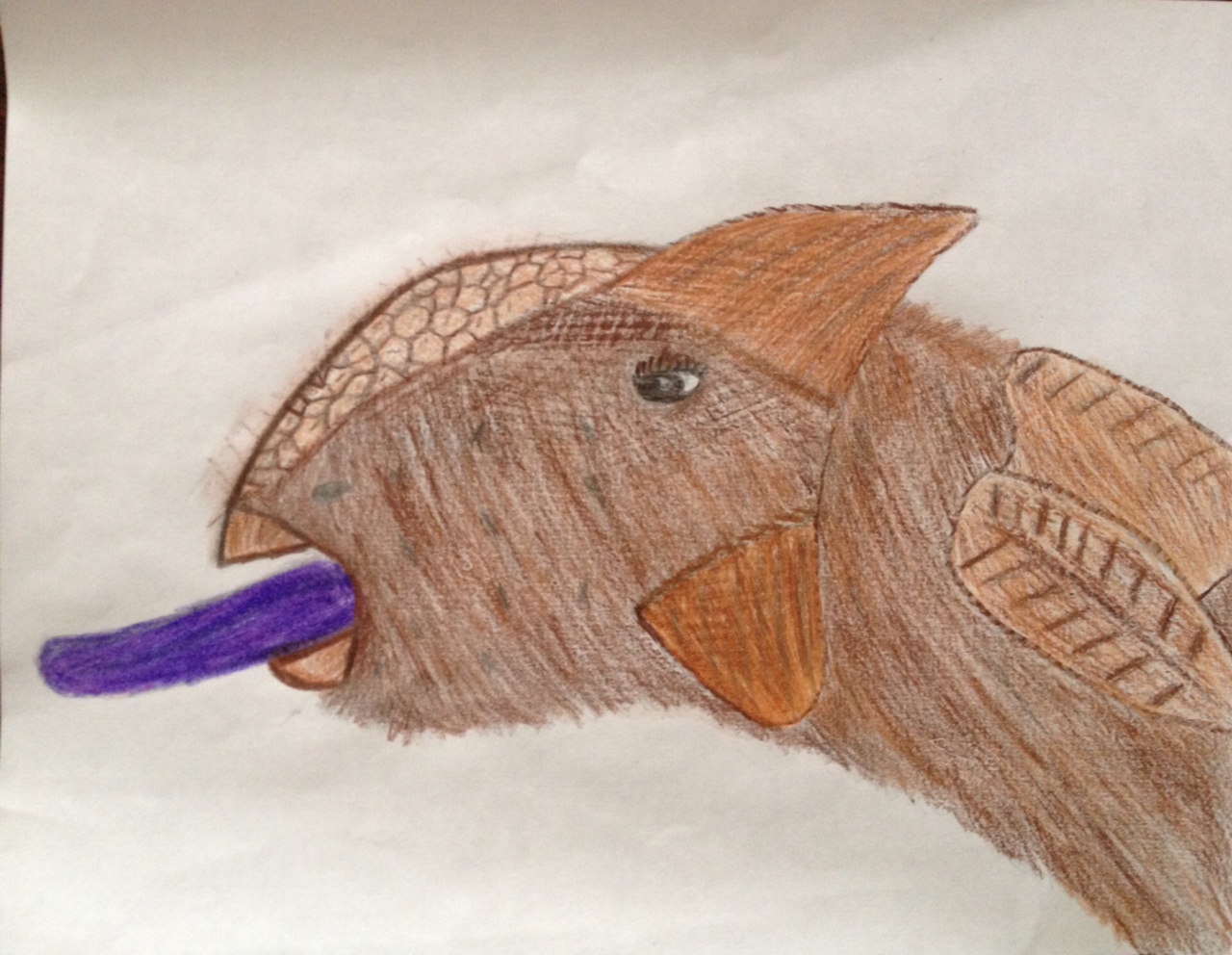
Beautiful amateur artwork by yours truly. But why the fuzz?
For those of you who have been checking my YouTube page, you may have noticed that I posted a new video, this time about the anatomy of the Ankylosauria. In it I talk about everything ankylosaur, as well as include an image by yours truly showing some speculative interpretations of their hyoids. However, in that same image I also portrayed the ankylosaur, which was based on Ankylosaurus magniventris, with feather-like protofeathers (a.k.a. dinofuzz or whatever it's called these days). Some people might think that this is due to scientists' current preoccupation with taking every dinosaur and slapping some feathers onto it, shattering the hearts of so many JP fans. However, I actually have a very good reason why I believe that not just Ankylosaurus might have had feathers, but also that it might be likely that the entire Thyreophora might've had such fuzz, even more than other large-bodied dinosaur groups. It starts with observations of another living group of animals: the Xenarthra.

Xenarthra are a group of mammals exclusive to the Western Hemisphere. They include freaky animal families like Armadillos, Sloths, and Anteaters, as well as awesome extinct forms like Ground Sloths and Glyptodonts. They are bizarre on so many accounts relating to their anatomy, such as having vertebrae that articulate differently than any other mammal, their lack of tooth enamel, and don't even get me started about some of their unsavory habits, like the recently documented observations of Linnaeus's two-toed sloth drinking from human latrines (Heymann 2010). Yuck...

It suddenly seems a lot less cute after discovering about its drinking habits.
I wonder how Kristen Bell reacted to that discovery...
Anyways, these guys seem to share some aspects of their physiology with thyreophorans, and no I'm not just saying that because they both have members that are complete turtle-mimics. Xenarthra are interesting in that they have the lowest body temperature and metabolic rates of any mammal, being at 40 to 60% what you would expect for mammals of their size (McNab 1980). This low body temperature makes xenarthrans somewhat slow-moving animals, and they have to face problems many people would typically associate with reptiles, such as having to regulate their body temperature and suffer a slower growth rate than other mammals. The latter trait is particularly important, as it's a trait also shared by thyreophorans.

The thyreophoran taxa Scutellosaurus (Padian 2004), Stegosaurus (Redelstorff 2009), and numerous American ankylosaurs (Stein 2013) have all been shown to have slowed growth rates when compared to other dinosaurs. They weren't as slow as reptiles, but definitely not as fast-growing as mammals. This suggests that like xenarthrans, the Thyreophora had a metabolism slower than other dinosaur families. There is, however, the exception of Kentrosaurus, which might have had a faster growth rate (Redelstorff 2013). However, Kentrosaurus seems to have been an exception, and the majority of evidence points towards thyreophorans having lowered body temperatures like xenarthrans. Whether or not their actual body temperatures were at comparable levels to xenarthrans we don't know, but seeing as how many scientists now consider dinosaurs to be warm-blooded on the same level as modern mammals, similar thermoregulatory levels between thyreophorans and xenarthrans might be expected. I'd like to see someone try to test this idea in the future.

So, what does this all have to do with an Ankylosaurus having fuzz? Well, everything really. You see, the main argument made by people against the idea that large dinosaurs had feathers, or any type of fuzz really, is that they wouldn't need it, being large enough to be able to have a stable body temperature, as seen on modern large mammals. I have my own issues with this idea, since it assumes that protofeathers and hair are the same kind of structure (which they are not), and that dinosaurs have a similar physiology to mammals (which is unlikely). However, even assuming such ideas, we still know of large-bodied mammals that live in tropical regions which have thick, shaggy fur, and they're xenarthrans.

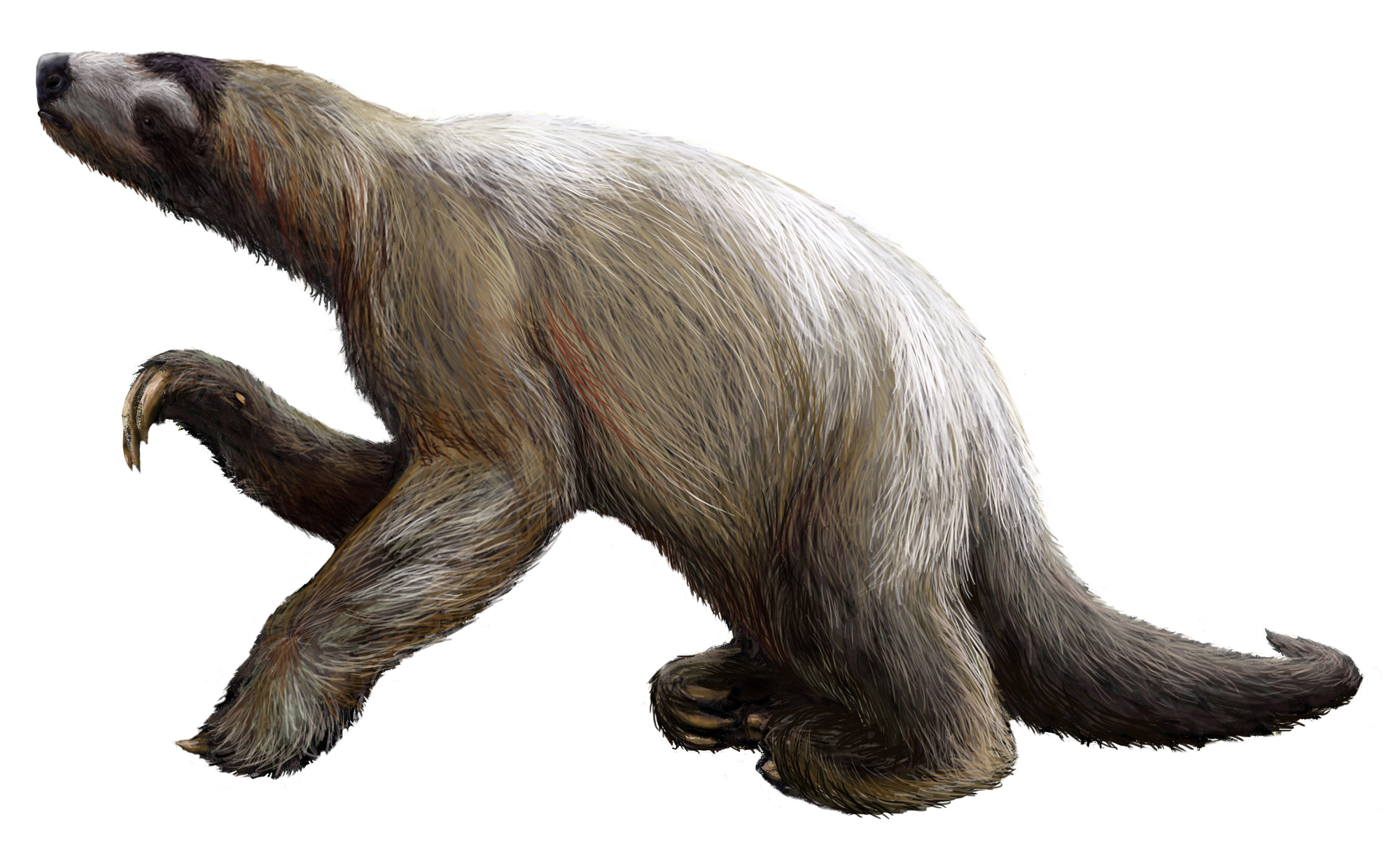
The Shasta Ground Sloth, a desert-dwelling sloth that was completely covered in shaggy fur.
Other members of the group were the size of an Elephant and just as fluffy.
Ground sloths are already so famous that they don't need an introduction. They are giant ground-dwelling sloths that were running around on the sides of their feet during the Ice Age, and alongside mammoths, were the largest animals in their environment. However, despite their size, they're often portrayed as being very fuzzy animals with shaggy fur. When in a discussion with someone the other day, they dismissed this as simply an assumption and asserted they were probably hairless like elephants. This is poppycock. We have mummified ground sloth skin from caves in Arizona, Nevada, Argentina, and Chile which show thick fur on the animals. We even have them preserved for Eremotherium, which was the size of a small elephant, and its likely that the fur is present in still larger members like Megatherium.

So this would seem contrary to what people say about large mammals shedding fur at larger sizes. Why did ground sloths keep their shaggy fur in tropical environments at such large sizes while other groups of mammals of equivalent size lost their fur? Our best answer is that this was due to their lowered metabolism, which means they had a harder time holding onto body heat than other mammals. Apparently holding onto that hair was also a pretty smart move, especially since ground sloths back then were perfectly able to extend their range up into temperate regions of North America and even as far north as Alaska during the last Ice Age, while living sloths have trouble tolerating even temperate latitudes. According to McNab, this was probably due to a combination of their thick fur, as well as greater size, larger muscle mass, and a constant food supply compared to their living relatives (McNab 1985).

So assuming that ankylosaur growth rates suggest that they had lowered body temperatures like xenarthrans, might we then expect that these guys were covered in shaggy fuzz, too?

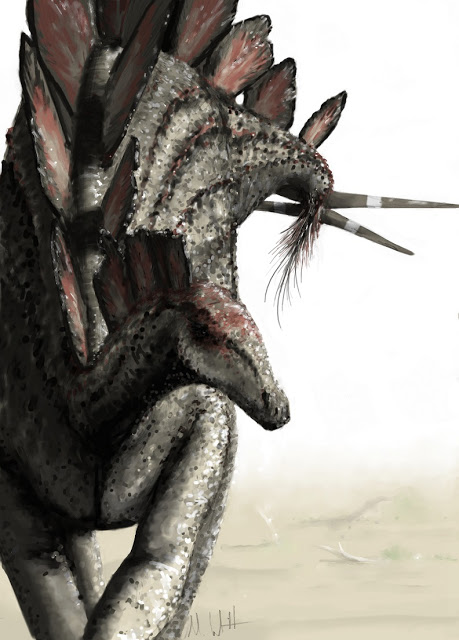
Stegosaurus with tail spines made of porcupine-like filaments. Art by Mark Witton.
Looks like other scientists got the memo, or they're just slapping feathers on everything again...
Thus, even assuming that they had a physiology similar to mammals, and the falsified assumption that protofeathers were similar to hair, our knowledge of their possible xenarthran-like metabolism would still make them candidates for long filaments covering their entire body. We also know that ankylosaurs at least lived in temperate environments, such as Liaoning, and polar environments like Alaska, Australia, and New Zealand. These guys would've needed even longer fur in order to survive the cold snaps, if they were xenarthran-like in their metabolism.

When you take all this into account, it almost makes the picture I drew kind of conservative, showing only short fuzz compared to the longer hair common on ground sloths. Perhaps I'm diving too deep into speculation right now, but I think that my idea holds some merit. What are your thoughts? As always I'd love to hear everyone's opinion on this.

Stay sharp! And make sure you check out my brand new Ankylosaur video on YouTube:


References:

Heymann, E. W., Flores Amasifuén, C., Shahuano Tello, N., Tirado Herrera, E. T. & Stojan-Dolar, M. 2010. Disgusting appetite: Two-toed sloths feeding in human latrines. Mammalian Biology doi:10.1016/j.mambio.2010.03.003

McNab, Brian K. (November 1980). "Energetics and the limits to the temperate distribution in armadillos". Journal of Mammalogy (American Society of Mammalogists) 61 (4): 606–627. doi:10.2307/1380307. JSTOR 1380307.

McNab BK (1985). Energetics, population biology, and distribution of Xenarthrans, living and extinct. In: Montgomery GG (Editor), The Evolution and Ecology of Armadillos, Sloths and Vermilinguas. Smithsonian Institution Press, Washington and London, 219-232.

Padian K, Horner JR, Ricqlès A (2004) Growth in small dinosaurs and pterosaurs: the evolution of archosaurian growth strategies. J Vert Pal 24: 555–571. doi: 10.1671/0272-4634(2004)024[0555:gisdap]2.0.co;2.

Ragna Redelstorff & P. Martin Sander (2009) Long and girdle bone histology of Stegosaurus: implications for growth and life history, Journal of Vertebrate Paleontology, 29:4, 1087-1099, DOI: 10.1671/039.029.0420

Redelstorff, R., Hübner, T. R., Chinsamy, A. and Sander, P. M. (2013), Bone Histology of the Stegosaur Kentrosaurus aethiopicus (Ornithischia: Thyreophora) from the Upper Jurassic of Tanzania. Anat Rec, 296: 933–952. doi: 10.1002/ar.22701

Stein M, Hayashi S, Sander PM (2013) Long Bone Histology and Growth Patterns in Ankylosaurs: Implications for Life History and Evolution. PLoS ONE 8(7): e68590. doi:10.1371/journal.pone.0068590

Friday, July 26, 2013

Pacific Rim and Kem Kem's Water-Loving Theropods

Striker Eureka vs. Otachi in a promotional poster for Pacific Rim
I just went to see the new blockbuster Action/Sci-Fi/Mecha,/Kaiju movie Pacific Rim on Wednesday, and by God it was awesome. It was by no means the best movie ever, being plagued with numerous stereotypes and clichés (and I heard some complaints of bad acting, but I didn't really notice that when I watched it), but for the most part it stood up very well. It had great CGI, cool Kaiju and Jaeger designs, and it knew exactly where, when, and what to do to please the audience, so I found myself thoroughly enjoying the experience, and I recommend the film to everybody even remotely interested in the concept. You won't leave the theater disappointed.

Director Guillermo del Toro took his inspiration from Japanese animes and Kaiju movies, and I could definitely see the resemblance to the former. I watch anime when I can, and many of the characters in Pacific Rim (despite undoubtedly being stereotypes) had an uncanny resemblance to characters in animes I had seen before. This was probably intentional on Guillermo's part. I also noticed some resemblances to Evangelion, an anime series with a similar story of giant monsters called Evas fighting human-powered mechas in order to protect the world. Other people have also noticed the similarities, but apparently Guillermo had never seen Evangelion, so all these parallels are probably coincidental.

Despite having seen numerous animes though, I've barely seen any Japanese Kaiju films before, so I couldn't see if there were any parallels there (other than, well, the fact they both have giant Kaiju in them). Maybe after seeing this movie it will encourage me to start watching some more Kaiju films. Hmm, I have always wanted to watch the original Godzilla movie.

Here's a funny story though. I've been watching another anime right now called Attack on Titan. It's about giant humans called Titans that eat normal-sized people alive just for fun, and how the last piece of humanity has been driven back into the dark ages and forced to retreat behind three giant walls that were built to keep the Titans out, but that's besides the point. The main antagonist's name in that show is Eren Jäger, whose last name has the same root as Pacific Rim's mechas, both being derived from the Germanic word for hunter (Jäger). *Spoiler Alert* This is also ironic seeing as mid-way through the show Eren learns he has the ability to transform into a Titan, and he uses his power in order to fight off the Titans as they slowly try to break their way past the walls to devour the people hiding within. So all in all, Attack on Titan and Pacific Rim are both about giants trying to annihilate the human race and both have heroes named Jaeger that are trying to protect what's left of it. Kind of left me confused...*Spoiler Ends*

There was, however, one HUGE problem with Pacific Rim that seriously brought down the movie for me. Watch this scene and you'll know what it is:


LIES!!!
Eh, I would devote this whole post to ranting about that one scene, but luckily, Darren Naish on Tetrapod Zoology did it for me, as well as talk about a lot of other cool aspects of the movie. Be sure to check that out when you can.

Now, onto important science-y things...

I made another video a few days ago which I posted on YouTube, this one concerning the Kem Kem beds in Morocco. I was inspired to make this due to a lot of work being published on those beds, notably a paper that came out a few months back by Emilie Läng and others, called Unbalanced food web in a Late Cretaceous dinosaur assemblage. I was able to read it about two weeks ago and was inspired to look more into the ideas presented. I then learned that Dale Russel suggested in 1996 a similar theory, I read a post by Duane Nash at another small blog called Antediluvian Salad on the topic, and I had a chance to watch an Attenborough documentary about the effects of the Salmon Run in Canada and what it does to the local predator populations. By the end of that, I had enough info for a video, so I made one. Voila:


It's an interesting idea, and while I'm not completely persuaded by all of its points, nevertheless I do like the theory and I have no particularly big reason to doubt it based on current evidence. Besides, the image of a Carcharodontosaurus ripping a shark out of the water is just dang cool. Land sharks vs. Sea sharks. :P

I've already gotten a lot of attention via PMs and comments about the theory, with people telling me why they agree or disagree with it. I'd like to hear your opinions about it too, so be sure to leave a comment and feel free to make a suggestion for future topics. Until next time...stay sharp, everyone! ;)

Saturday, July 13, 2013

"Porpoise Turtles" and Repenomamus

Well, this goes right up there with Sharktopus, Dinocroc, and Pizza the Hut.
(Are you catching the movie references?)
Marine reptiles are awesome. One of the "big three," as I like to call them, (the other two being Dinosaurs and Pterosaurs), marine reptiles are any group of reptiles that evolved into an aquatic niche. They include a number of unrelated groups, from giant marine squamates like Mosasaurs, to sauropterygian Plesiosaurs, to living Marine Iguanas. I get the honor of seeing some of the best extinct marine reptile specimens in the world every week, at my local museum where I recently began to volunteer. It has both the world's most complete Mosasaur as well as the only known specimen of a pregnant Plesiosaur on display. It's a nerd's paradise. Hopefully I can take some pictures of the specimens to share with you in the future.

While I would like to discuss those specimens in depth, I'll have to do that at another time. Sea turtles are going to be the topic of today's post. What few realize is that sea turtles are the only marine reptile family known to have survived the K-T extinction into modern day. You're probably all familiar with the extinct giant sea turtles like Archelon and Protostega, which are within a family called the dermochelyoidae, whose sole surviving representative is the Leatherback sea turtle (Dermochelys coriacea). However, recently on PLOS, a new member of the giant sea turtle family was announced, named Ocepechelon bouyai, which has to be one of the most awesome sea turtles I've ever seen.

A big, weird, and freaky skull.
Almost hard to believe it comes from a turtle...
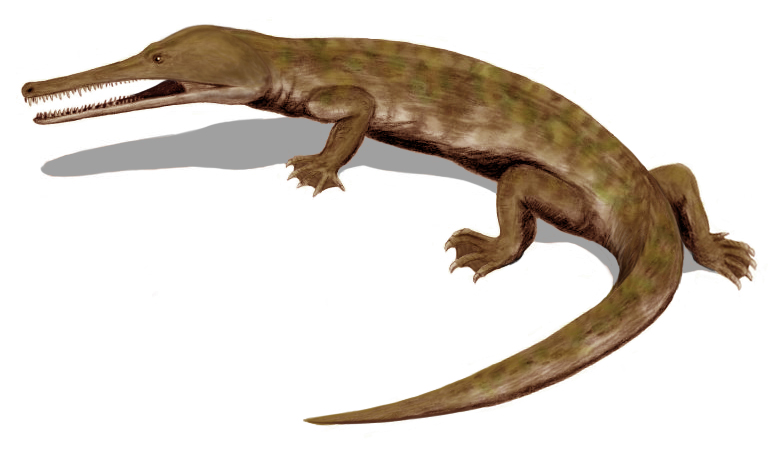
Why is Ocepechelon so awesome? Because it is just plain freaky (but in a good way). When I first saw the artist's rendering above, I almost thought it was a fish-eating crocodilimorph like a Phytosaur (by the position of the nostrils), but after reading it was a turtle I was shocked. Its skull (which is sadly the only part we have from this giant) was more than two-feet long, elongated, and tubular, and a horny beak, while probably present, would've been extremely abbreviated and ineffective in capturing prey. The fact that this giant was found in late Maastrichtian rocks of Morocco makes it even more exciting, as we lack virtually any fossils from Late Cretaceous Africa.

Ocepechelon's living habits are even more amazing. The authors make a compelling case that this guy was a suction feeder, and they drew a huge number of adaptations for such a lifestyle. However, he is unique among tetrapods in apparently being a pipette-feeder, like seahorses and pipefish. While most suction feeders alive today have short, wide jaws to maximize water flowing into their mouth, these fish focus on smaller prey and pick them out of the water selectively. Apparently Ocepechelon fed in a similar way as seahorses and, to a lesser degree, beaked whales, which it shares numerous adaptations with as well. The latter features inspired the nickname I posted above: the Porpoise Turtle.

So, great job to the researchers who discovered and described Ocepechelon! He's now officially my favorite Mesozoic sea turtle, and he's just further evidence that the Mesozoic was teeming with reptile diversity. A lot of recent research into other reptile groups outside of the big three also shows that virtually every reptile during the Mesozoic was doing great. We have fossil squamates, snakes, mesosaurs, crocodilians, and sphenodonts running around during the Mesozoic, doing all sorts of things. Almost makes me feel sad for small mammals, as they were the only Mesozoic group that had virtually no diversification. As with most everything, however, there were a few exceptions.

There are a few really cool mammals that lived during the Mesozoic. Repenomamus, the dinosaur-eating mammal found in Yixian, is one of my favorites, as it has guts. These guys reached huge sizes compared to other mammals, exceeding ten pounds, which is a lot for a mammal back then. Not just that but one specimen was found to have a baby Psittacosaurus in its gut, showing that these guys ate dinosaurs. The four-episode Discovery television series "Dinosaur Revolution" had a few clips that included small mammals, such as the beaver-like Castorocauda and flying squirrel-like Volaticotherium. I understand they were also going to include a section on Repenomamus, but it got cut from the project. Nobody knows why the segment got scrapped, but my guess is because it included the now-dubious taxon Raptorex kriegsteini.

Luckily, I was able to find a storyboard sequence of the scene on YouTube. Enjoy, but be warned...I was ROTFL so much after watching this. :)

Until next time, stay sharp!


Click here for Part 2:
References:
Nathalie Bardet, Nour-Eddine Jalil, France de Lapparent de Broin, Damien Germain, Olivier Lambert & Mbarek Amaghzaz (2013) A Giant Chelonioid Turtle from the Late Cretaceous of Morocco with a Suction Feeding Apparatus Unique among Tetrapods. PLoS ONE 8(7): e63586. doi:10.1371/journal.pone.0063586

Tuesday, July 2, 2013

Awesome Pterosaurs and the Blog's Promo-Video

Well as I said before, since I just finished up with school I am getting more free time to do more things, like write on here. However, recently I've been caught up in reading Mark Witton's new book Pterosaurs (which BTW, is probably the best book on these extinct reptiles to date, and I highly recommend it to anyone even remotely interested in them) and have not had the attention span to tear myself away and write a new post, and during the time that I wasn't reading, I was getting ready to submit my new-and-improved version of my article to AncientPlanet Online Journal.

However, to make up for the lost time, I decided to make a new video, which I posted on YouTube yesterday covering Pterosaur diversity. It includes some new scientific information revealed in the book, as well as coverage of many of the extremes of pterosaur diversity. Enjoy:


After I was done with that, I decided that I needed something to spice up my YouTube channel and get more publicity for my blog, but I couldn't put my finger one what. Then it hit me. I needed something to promote it: a promotion video! So, I decided to throw this together over the weekend and put it up earlier today. It's not the best video I've ever made, and I was limited to using only my Windows Movie Maker program (which isn't the best for these types of videos) but I'm still pretty proud of it and it's a good start.

 
If anyone here has a suggestion for a future blog post or video, or simply has a question they'd like to have answered, feel free to send it by me. As always, stay sharp! ;)