Tuesday, January 22, 2013

All Yesterdays Tribute

So for the few of you that have either been living under a rock, or simply not been in touch with the paleontological community lately (hopefully the majority of you are the latter), Paleoart has taken a major turn for the better with the the publishing of All Yesterdays: Unique and Speculative views of Dinosaurs and Other Prehistoric Animals. Authored by Paleoartists John Conway and C. M. Kosemen and Paleontologist/Zoologist Darren Naish, this book has caused so much of an impact that its been compared with Bakker's famous The Dinosaur Heresies, one of the greatest published milestones in paleontological history. Thus, I thought it may be appropriate to create a tribute to such an amazing book, and I did:


I know its not anything special, just something I basically threw together during my long weekend, but it is a beginning point for me. I'm hoping to make more videos and put them on my YouTube channel to address more important paleontological discoveries, issues, and debates in the near future.

Until then, I'm going to do one of 3 things; study dinosaur lactation (yes, a study came out the other day talking about this), research terrestrial island crocodiles, or sleep. Most likely the last option though....

Monday, December 31, 2012

Dino (and Mammal)-Eating Crocs Part 3: The First Neosuchians

*Before I start, I must apologize for misusing the term Crocodilian in my last post concerning these animals. Crocodilian is used to define all the members of the Crocodilia, which include living crocodiles and all their closest extinc relatives, and not the Notosuchian + Neosuchian branch Metasuchia. Instead, the more broad term in considered to be Crocodylomorph, which is what I will use in this post.
 
Image of Stomatosuchus inermis, a large Crocodylomorph from mid Cretaceous Africa.
Its toothless lower jaw and possibly pelican-like throat pouch are just one example of diversity in the Neosuchia.
As I had shown in the previous post concerning Notosuchians, during the Mesozoic all kinds of these reptiles were running around under the feet of dinosaurs, and in some cases, directly competed with them for resources, territory, and living space. However, the other group of Crocodilimorphs, known as the Neosuchia, were just as, if not more diverse as their Neosuchid brethren, and exploited another type of environment; the water. Such a high level of diversity should really be expanded longer than a single blog post, but in an effort to save time, I'll be just quickly scanning though a few of the various groups and families.

The earliest known Neosuchian, called Calsoyasuchus valliceps, dates back to the early Jurassic, and predates the Neosuchia by almost 90 million years. However, despite being so old, Calsoyasuchus is a fairly derived form of Crocodilimorph, being a member of the Goniopholididae family, and suggests the Neosuchia originated even earlier. Goniopholididae were the first group of semi-aquatic Neosuchians, and would've resembled modern crocodilians in many ways. However, they lacked many defining characteristics, such as a well-developed secondary palate which allows them to breath while their body is submerged, and would've probably needed to lift most of their head out of the water to get a gulp of air.

More primitive Neosuchians only occur later in the fossil record. The Atoposauridae are often thought to be the most primitive family within the Neosuchia, but they don't appear until the late Jurassic, leaving another 30 million year gap between them and Calsoyasuchus. They seem to have been primarily land-living animals that resembled armored monitor lizards, and were probably filling a similar niche to them in the shadows of dinosaurs. As time went on, however, this certainly did change. While both the Goniopholididae and the Atoposauridae represent the earliest offshoots to the group, the second offshoot, however, has been getting more press with the discovery of Dakosaurus; the Thalattosuchia, or sea-crocodiles.


Image showing just a few species of Metriorhynchids with a diver for scale.
Despite the image portraying a 4.5m Dakotosaurus, some species may have rivaled
Plesiosuchus in size.
The Thalattosuchia are as far as we know the only crocodilians adapted towards a fully pelagic existence. They evolved during the mid Jurassic and persisted into early Cretaceous times, and are separated into two families; the very crocodilian-like Teleosauridae and the very fish and whale-like Metriorhynchidae. The Teleosauridae  have elongated jaws, and are thought to have been primarily shallow water piscivores, although some members like Machimosaurus have their teeth regularly found embedded within turtle shells. They show numerous adaptations for diving, however, such as big neck muscles and short, compact bodies, but still hold onto the elongated crocodile-like tail of their ancestors. The Metriorhynchidae were much more whale-like in appearance as well as feeding methods, sporting killer whale-like teeth, and many having shorter porpoise-like snouts. These were presumably the toothed whales of the age, and being equipped with well-developed salt glands, fish-like tails, and flippers, they lived a fully aquatic existence. They are also currently believed to be the only members of the Archosauria to be ovoviviparous, in that they likely held onto the young in the body and gave live birth to them.

However, despite often being considered members of the Neosuchia, some recent cladistic analysis of these animals have suggested that they may be more primitive, perhaps even outside of the Metasuchian branch altogether, and thus I shouldn't be including them in this post. For a more in-depth review of this as well as any information you may want to know about these creatures, see Darren Naish's recent article concerning these animals.

Next are possibly one of my favorite families among the primitive members of the Neosuchian branch, the Mahajangasuchidae. So far the family has only been identified by two species, both from Africa, Mahajangasuchus insignis from Madagascar and Kaprosuchus saharicus from the Sahara. They are characterized by their short and deep jaws, horn-like projections over the eyes, and fused nasal bones, the latter trait they share with the tyrannosauridae. They also both show adaptations in their skulls that suggest a largely if not fully terrestrial existence, such as more laterally positioned forward-facing eyes. In the case of Kaprosuchus, it had six pairs of elongated teeth and an armored nose, which may have allowed the animal to kill large, land-based prey.

Kaprosuchus has been getting some attention ever since its discovery, and has been portrayed on National Geographic's special When Crocs Ate Dinosaurs, as well as the British television series Primeval. Despite not really realizing it, Mahajangasuchus has gotten some screen time as well. In the 2005 remake of King Kong by Peter Jackson, they portrayed in a short scene a crocodile-like creature chasing after the lead heroine Ann Darrow before getting eaten by a T-rex-like animal. The creature was later confirmed in a "Natural History Book" about Skull Island to be known as Foetodon ferrus, but looking over its anatomy, its overall build and size shows an uncanny resemblance to Mahajangasuchus, and I wouldn't be surprised if it was based on the latter.


Image comparing the giant extinct Pholidosaurid Sarcosuchus to a living crocodile.
Their has been a debate as to what Sarcosuchus was eating; mostly land-based dinosaurs,
 or mostly fish. I personally find the later more likely. Sorry Sarco fans...
The Tethysuchia are a group of crocodilians which evolved near the end of the Jurassic, and survived into the Paleogene epoch. Within this group their are two families, the Pholidosauridae and Dyrosauridae. The Pholidosauridae, which includes Pholidosaurus, Meridiosaurus, and the infamous "Super Croc" Sarcosuchus, which was one of the largest Crocodylomorph to have ever existed. They were primarily long-jawed predators of fish with widened, bulbous noses, but some species of bucked this long-jaw trend entirely; Oceanosuchus had jaws similar to a modern day Alligator. The Philosauridae went extinct about 90 million years ago, likely after suffering heavy losses after the Cretaceous Thermal Maximum (CTM).

The Dyrosauridae were similar to the Pholidosauridae in many aspects, and are their sister group, but came about 20 million years later in geological time. They appeared about 70 million years ago and survived the K/T event that wiped out the dinosaurs. Most had, like the  Pholidosauridae, elongated jaws with numerous teeth, suggesting again, a mainly piscivorous lifestyle, though some species, such as Phosphatosaurus, had more traditional crocodilian-like teeth and jaws. This group survived up until their extinction in the Eocene, likely being victims of another small extinction event hat occurred at this time, although their disappearance could also be explained by competition withthe more advanced crocodilians.

Next come quite possibly, in my opinion, the most extreme members of any Crocodylomorph lineage. The Stomatosuchidae were a small family, like the Mahajangasuchidae, and have only two currently accepted genera. The first discovered was Stomatosuchus, which was unearthed by Ernst Stromer during one of his expeditions to Egypt, but was sadly lost along with the original Spinosaurus and Carcharodontosaurus remains during WW2. The second was Laganosuchus, which was described and discovered by Paul Sereno in 2009.

The original remains of Stomatosuchus were not very complete, but it suggested that the animal was over 30ft in length. Laganosuchus was probably smaller, reaching a little over 20ft. The upper jaw had tiny teeth, but the lower jaw may have been toothless (although Laganosuchus has small teeth in it's lower jaw). While Sereno has suggested that these animals may have been ambush predators, waiting jaws open for something to swim into them, I'm sceptical of this. The wideness of the jaws would produce a lot of drag in water, preventing them from being closed effectively at high speeds. Any rapid movement of such wide jaws would've also produced currents that would alert the fish of the danger through it's lateral lines, if not carry the fish out of their jaws entirely.

I instead believe that, since their jaws show similarities to living whales, these animals may have been hunting fish through filter-feeding. Perhaps they actively followed after schools of fish, swallowing them in gigantic mouth fulls. It would've certainly been a niche that they could fit into nicely, seeing as the only other creatures hunting like this at the time were gigantic fish in the family pachycormidae, and even these huge fish were likely feeding on tiny plankton rather than other fish species. So it seems the stomatosuchidae had this unique lifestyle and feeding habits to keep all to themselves. (although another  Crocodylomorph family, the aegyptosuchidae, may have been doing similar things)
________________________________________________________________________________

So their we go. I know it is a bit short, but I told everyone I'd try to get this done before the end of the month, and I was running out of time.

Still, I'm not done yet, and I'd really like to get into some more crocodilians next time, including more modern crocodilians that are all scattered across the past. I've also been facinated by a species of land-living (if not arboreal) crocodilan that may have crossed paths with early Homo sapiens, and you can be sure it will be talked about sooner or later. ;)

Monday, December 24, 2012

Happy Holidays!

Hey everyone! Just making this quick little post to wish you all a Happy Holidays and great New Year. The next crocodilymorph post is almost done, although I may have to separate it into two parts since the Neosuchia is such a vast family to cover. Other than that, I'm hoping I'll be able to post some more things on here for the next few weeks before school starts again. I'm also working on some other post (if you haven't realized it yet, I just right about whatever I'm looking into at the present time) and hope they'll be done before school starts next year.

Anyways, as I said before, I wish you all a very Happy Holidays and hope to see you all soon....

Saturday, December 22, 2012

Anatomy and Paleobiology of Spinosaurid Dinosaurs

Illustration by Brian Engh depicting two Spinosaurus aegyptiacus doing what their family does best:
fishing, and swimming.
Recently, I have been speaking with a number of people online concerning the life habitats and paleobiology of the spinosaurid dinosaurs, which is a family of highly specialized theropods that had evolved aquatic habits and are known to eat fish. The information we've been discussing has certainly inspired me to do a post on these animals, and they're one of my personal favorites among theropods due to their bizarre appearance and specialized behaviors.
 
Spinosaurids were a family of dinosaurs within the megalosauroid radiation of tetanuran theropods which seem to have evolved during the late Jurassic. While original spinosaurids remain limited their range to North Africa, South America, and Europe in predominantly swampy and tropical paleoenvironments, the last five years has revealed remains from every continent (excluding Antarctica, although I bet we'll eventually find them there). An ungual phalanx from the famed Morrison formation is also thought to be from one of these animals, and a neck vertebrae from Australia has been found to come from a juvenile spinosaurid. The latter is from the same locality that we're currently finding a number of polar dinosaur species, proving that these animals weren't limited to swampy environments.
 
Combinations of stomach contents, shed teeth, and even embedded bones from prey within the jaws of these animals prove that they were piscivores, and fed on a diet of fish. A study of oxygen isotope levels in spinosaurid teeth have also shown that they were indeed spending the majority of their time submerged within water, and perhaps actively swimming after fish in their underwater world. However, the discovery of bones from a sub-adult Iguanodon within the European Baryonyx specimen, along with a pterosaur vertebrae with part of a spinosaur tooth embedded within it prove that despite their fishy diets, they were still capable of feeding on land-based prey. The fact they were aquatic may also suggest that some of these theropods were feeding on marine reptiles like plesiosaurs and icthyosaurs. We have found marine reptile bones and teeth in some of the same deposits, but this is all speculative until any evidence is found that they preyed upon these animals.
 
Body Builders of the Mesozoic?


Image of armature paleontologist William Walker with the thumb claw of Baryonyx walkeri in his hand.
The individual Baryonyx who left this claw was about 9 meters long, and it was not even fully grown!
 
A common trait seen in many, if not all members of the spinosauridae is their well-developed arms. Despite many people claiming that these animals had long arms, they aren't particularly long compared to other theropods, the obvious exceptions being tyrannosaurs and alvaresaurids among others. Instead they are well-muscled and very robustly built. The lower arm bones are relatively short, but the humerus length makes up for it. The fingers show a high degree of flexibility like many big theropods, and the thumb was tipped with an extremely large thumb claw.
 
Many have suggested that these arms were used for fishing, rather like how a bear will use its forelimbs to catch salmon. However, similar robust arms are also seen in earlier Megalosauroids, so perhaps their use was the same throughout the group. Megalosaurs are thought to have used their robust arms to help with dispatching large land-based prey animals, and we know currently that Spinosaurids at least occasionally fed on dinosaurs, so perhaps their arms were used to kill them as well. Still, they would have also served very effective for fishing when the time came.
 
Billboards, Fish Traps, or Giant Humps?

Skeletal reconstruction by Scott Hartman showing the full extent of some Spinosaurus vertebral spines
Wonder if I could advertise my blog on one of those things....
 
The most noticeable part of any spinosaur must be the elongated dorsal neural spine along their backs, producing a "sail" or ridge along the backbone. In some species these became very elaborate: Spinosaurus itself has neural spines which were over five feet tall, and Ichthyovenator had not one, but two sails along its back.
 
The evolution and purpose of these sails has been at the center of a hot debate. Some scientists think that they may have served a thermoregulatory function. Many of these creatures were living in some of the hottest environments the Mesozoic had to offer, and these vertebrae could serve as extra surface areas to cool down the animal during the hottest parts of the day. However, if the animals were really spending a lot of time submerged in water, this may not have been a problem for them, as the water would keep them cool. The sails may also have served as visual display organs. Similar structures are found in other dinosaurs and living animals, and may have served as billboards to advertise to other animals their age, size, gender, species, and overall health. The sheer number of sail shapes and forms found within the group supports the idea they were for some form of visual communication, and I agree that that is likely one of their functions.
 
Another theory I have heard be suggested is the fishing lure idea. Some living birds like herons use their wings to shade the water around them, which attracts fish to the animals where they can then be easily snatched up in their bill. Some have suggested the same thing was happening with spinosaurids, using their sails to shade the water and attract fish, but I personally find myself disagreeing. Many species have low ridges that could not serve such a function, and the sails are thought to appear as an offset to sexual maturity, further suggesting the visual idea.
 
Stromer had his own idea for the sail, however. He suggested that the sail may have supported a hump-like structure filled with muscles. While originally dismissed for the sail-backed animal, Jack Bailey resurrected the hypothesis in 1997, and reconstructed what looked like a giant terrestrial crocodile with a bison-like hump on its back (similar to the extinct archosaur Arizonasaurus). However, this posture and reconstruction now seems, at best, unlikely, but the hump theory still isn't out of the question. As both he and Stromer noted, the sail is made up of thick and strong vertebral extensions, a far cry from the thin extensions in some sail-backed animals, like Dimetrodon, but very similar to the thicker extensions in living hump-backed animals, like bison and camels.
 
Living bison use these muscular humps on their backs to power huge neck muscles for both plowing through snow and head-butting mates during the breeding season. Camels use their humps to store fat (NOT water) while traveling over large desert landscapes. Bears also have muscular humps over their shoulders to power huge arm muscles while hunting, digging, and moving large objects (in some cases even boulders weighing over a ton), but how would the spinosauridae possibly use such a structure?
 
Investigation into the neck vertebrae in spinosaurids suggests that, while they had rather weak side-to-side motion in the neck, they had well-developed muscles responsible for the up-down motions. Such a fast up-down motion might be good when catching fish and raising them out of the water while swimming, and any muscles in this sail may have assisted them while hunting. The well-developed arms of spinosaurs may also have been powered by muscles that extend into these structures, although as I mentioned about megalosaurs, they would have still been powerful without them.

 
One of the best and most used skull reconstructions of Spinosaurus I've seen on the net, with the rear proportions based off its relative Irratator.
The image is from Andrea Cau's Theropoda blog, although I don't know the exact origins of it (except it's modified by S. Maganuco).
 
Leaving their vertebrae, we of course come to their next most defining feature in spinosaurids: their heads. The skulls of spinosaurs were all low and elongated, similar to a crocodile, and due to their fishy diets it's no wonder why. However, despite this general shape, the skulls between different species can differ dramatically between the two subfamilies; the Baryonychinae and the Spinosaurinae.
 
The skulls of members of the baryonychinae are known for their moderately raised nostrils, rounded eye socket, numerous closely-spaced teeth, shallow lower jaw, and extremely small, but numerous serrations on the teeth. These animals include Baryonyx walkeri and Suchosaurus cultridens from Europe (although the latter may be dubious), the African Suchomimus tenerensis, possibly Ostafrikasaurus crassiserratus (if it's not more primitive), and Cristatusaurus lapparenti (again, the latter may be dubious), the Asian Ichthyovenator laosensis, and presumably the newly discovered Australian specimen, Morrison specimen, and a Campanian tooth from China all belong to members of the the baryonychinae.
 
The defining skull features members of the spinosaurinae share is their extremely high nostrils (half way up the skull), raised teardrop-shaped eye sockets, widely-spaced and relatively longer teeth, deeper lower jaw, and lack of serrations. These members so far include the African Spinosaurus aegyptiacus, the South American Irritator challengeri, the extremely fragmentary Oxalaia quilombensis, and possibly Siamosaurus suteethorni (since its teeth closely resemble those of Spinosaurus).
 
Both groups have raised nostrils, which helps them to breathe while submerged. In the spinosaurinae they are especially high up, which allows them to still breathe in deeper water, and the eyes are also partially raised, allowing them to also see while submerged. This could possibly indicate that the spinosaurinae were more aquatic than the baryonychinae, and the large sizes of some members of the spinosaurinae (both Spinosaurus and Oxalaia could get larger than Tyrannosaurus) may have been supported by the weightlessness of this lifestyle.
 
The differences in jaw morphology may also reflect different lifestyles among the two groups, most notably spaces between their teeth. The teeth of the baryonychinae were uniformly-spaced, while the teeth of the spinosaurinae had spaces which varied. The former arrangement is more similar to living fish-eating gharials, which have interlocking teeth to allow them to more successfully catch small slippery fish. However, the latter spinosaurinae have an arrangement that is more similar to other types of crocodilians, and might suggest that like them, their diet was more varied. Alternatively, varied spaces between teeth are also seen in crocodilians which feed on larger prey, so it is also possible that the spinosaurinae were feeding on larger prey items than the baryonychinae.
 
Comparisons between the skulls of different types of spinosaurids have been going on for a while now. Donald M. Henderson started it off in 2002 when he examined Suchomimus's skull and found that it was weaker in comparison to the skulls of the much smaller dinosaurs like Dromeosaurus. This was due to the skull's weaker build compared to other theropods, which have taller skulls in order to counter-act stresses while biting. In 2007 Emily Rayfield made similar findings in the closely related Baryonyx walkeri. However, paleontologist Andrea Cau posted on his blog Theropoda about the skull of Spinosaurus as well as members of the spinosaurinae, and suggested that unlike the baryonychinae, it may have had a much stronger bite.
 
He noted numerous adaptations in the skull which could be responsible for a more powerful bite force, and I quote:
 
"How powerful was that bite? A precise quantification is not possible, however, it should be noted that increasing the length of the rostrum, increases the moment of the force exerted by the muscles mandibular end of the rostrum. The long skull of a Spinosaurus was adapted to withstand the forces exerted by its own bite? The cross section of the rostrum, triangular, the presence of the long nasal dorsal ridge which served as a point of discharge of the forces and the presence of the long secondary palate (a mechanical expedient to resist torsion), all adaptations are intended to support the intense stresses caused bites very powerful. A further indication of this capability is given, at least in Spinosaurus, from the retracted position of the nostrils: this odd fact that the entire region was placed in front of the nostrils consists of only compact bone, with no cavities or soft part, and then allowed to exercise precisely at the level of the rostrum of the considerable pressures without the risk of damaging vital parts such as the nostril."
 
This suggested to me that unlike members of the baryonychinae, the spinosaurinae were better adapted to feeding on a range of animals from fish, to pterosaurs, to dinosaurs with their more powerful bites. However, while writing this article I came across yet another paper concerning the strengths in spinosaur skulls published in 2011 (again by Emily Rayfield). This study was similar to the Baryonyx one in that she digitalized the skulls of 7 different theropod species, including Suchomimus and Spinosaurus, and put them under stress in a 3D computer program to see which ones were most effective at distributing it. The results were surprising.
 
Out of all the dinosaurs in the study, the three largest theropods, Acrocanthosaurus, Carcharodontosaurus, and Spinosaurus had the highest levels of stress in the skull. Spinosaurus especially showed levels off the main curve, and was likely unable to feed on larger dinosaurs, being restricted to smaller prey. Ironically, this study found that despite Henderson's stating that the skull of Suchomimus was incredibly weak, this study found that it was in fact just as good at distributing stresses as the other theropods graphed, and the skull was overall much stronger than Henderson thought.
 
I am, however, reluctant to make these seem like conclusions since Emily herself stated that they could not be 100% sure that the results were accurate based on the resources she had. She instead suggested that the study should be considered more of an educated prediction, and should be tested with the offset of better 3D models in the future. I personally can't wait until such advances are made and we can more accurately find out how these skulls worked, and thus learn how these creatures behaved.
 
Why, what big teeth you have!


Image of the jaw of Baryonyx from Emily J. Rayfield's paper reguarding its skull
As you can clearly see from image B, spinosaurid teeth were extremely long.
 
But of course, one of the most interesting things I'd like to get into is these animal's teeth. The teeth of all spinosaurs show some of the greatest examples of convergence within the theropods, greatly resembling crocodilian teeth to the point that we have trouble telling isolated examples of the two apart. Both croc and spinosaurid teeth are nearly conical in shape and appearance, but in the baryonychinae, these teeth still held onto serrations along the front and back like other theropods, but are so small that they can only be seen with a microscope. The spinosaurinae teeth have become truly conical and have no serrations present, but also tend to be thicker as well as larger than baryonychinae teeth. Both groups also show large amounts of wear on their teeth. Similar wear is seen in crocodilians, marine reptiles, as well as some toothed whales, further evidence that these were aquatic animals.
 
Oxalaia is also unique from all other theropods in one regard. The tooth in the third row has shown not one replacement tooth behind the functioning one, but two. This is unusual as replacement teeth tend to grow one at a time in most theropods. For those that don't know, both dinosaurs and crocodiles replace their teeth by resorbing the existing tooth at its base to make room for the replacement. The replacement eventually moves to a position within the functional tooth, and when resorption is largely complete, the existing tooth falls away, allowing the new tooth to take its place.
 
The fact that Oxalaia has two replacement teeth within one socket means that it would've been resorbing and producing two teeth at the same time within one another, almost like Russian nesting dolls. Due to the fact we only have one extremely fragmentary Oxalaia specimen, we can't tell if this was a "freak" individual or a trait the species had as a whole, but it certainly shows these animals were weird in their own ways. However, I haven't even gotten to one of the most significant things about these teeth in my opinion: their sheer size.
 
Many people just don't realize that how big spinosaurid teeth were. At first glance the teeth of spinosaurids may seem about the same size as those of other theropods, despite their odd shape. But CAT scans of the skull have shown that their roots were extremely deep, sometimes embedded half-way within the socket. Similarly deep roots are also seen in, again, crocodilains, but in Spinosaurus itself these teeth may have been over 10 inches long, rivaling T-rex's banana-sized 12 inch teeth for the longest theropod tooth! It has surprised me just how little documentation exists about the size of spinosaurid teeth, and very few people I've talked to know how long they actually are. Many scientists have referenced the length of these teeth in the past, such as Thomas Holtz, who has talked about their length in the documentary Monsters Resurrected  as well as while answering questions online.
____________________________________________________________________________________
 
So that's it. Thanks to everyone who I've been talking to about these fascinating creatures, and hopefully talking about these crocodile mimics will get me back in the mood to write about actual crocs....
 
Eh-hem....
 
As always, feel free to ask any questions you may have. But to make it seem a bit more exciting around here, you get extra points if you understand the Holtz reference. Until next time, stay sharp and see ya around the net. ;)

Tuesday, December 4, 2012

Digging on the Net: Birds of Paradise

A few weeks ago, I found myself walking down my driveway after a long day of school. I turned to my left and saw the mail had come in, so I decided to grab it and save my parents some trouble. However, I noticed I got a new edition of National Geographic magazine in the mail, and one of the sections listed on the cover said something about the Birds of Paradise, scientifically known as the Paradisaeidae, and are best known for their spectacular and diverse plumage in males. I entered my house, dropped all my things on the way up to my room, and quickly indulged into the world of these spectacular and diverse birds.

It turned out that after 8 years of looking and studying Birds of Paradise, photographer Tim Laman and Cornell University ornithologist Ed Scholes were able to be able to document and photograph every living member of the family, including the never-before photographed and rarely ever witnessed Buff-Tailed Sicklebill. Their discoveries and footage include never-before seen views of these animals, and completely unexpected realizations about their mating behaviors. I wasn't going to make a post about this, but a recent National Geographic Live! interview has given me a good chance to show you all just how spectacular these creatures are:


I know there's been a lot of bird-related things on this blog recently, but expect it, since birds are the living representatives of Dinosaurs, and in my opinion, we should be basing Dinosaur behavior off them. In my opinion, if a bird practices some type of behavior, then Dinosaurs probably would've done similar, of not the same behavior. And yes, that includes the possibility that male T-rex were dancing around, clearing areas on forest floors in order to make them seem sexier to females of their species.

Yes, I know, I'm working on the Neosuchian post. I'm just stuck on this one part and currently looking for the information to refresh my memory on it. It'll be within the month, but expect some shorter posts in the meantime.

Thursday, November 22, 2012

Happy Thanksgiving

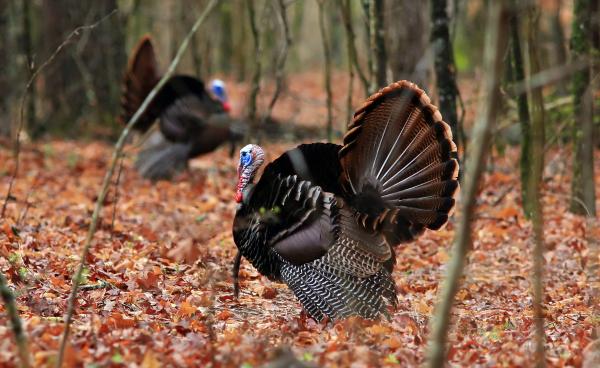
Two male Wild Turkeys performing their characteristic "strutting" behavior.

For this quick post, I'd like to say Happy Thanksgiving to all my American followers here, and talk briefly about one of America's National emblems, the Wild Turkey (Meleagris gallopavo). Often taken for granted by us humans, and often described as very dumb birds, Wild Turkeys are greatly misunderstood animals, which encourages me to devote a few paragraphs here to discussing them on what should be considered their own national holiday.

The Turkey is the largest living member of the Galliformes, or gamebirds, a group of about 290 species of mostly terrestrial birds that have compact bodies, small heads, short beaks, and high-wing loadings. Galliforme young are precocial, which means that they are able to walk within hours of birth, and in the case of Megapodes (large gamebirds from Australia and surrounding areas of land) their young are superprecocial, and are able to fly within their first day out of the egg.

Gamebirds as a whole are a very successful group; they've colonized every continent except Antarctica, and are found everywhere from tropical rain forests to frozen tundra. They are well known for often showing extreme forms of sexual dimorphism, and males are often larger than females and have almost excessive amounts of display plumage, which reaches its most extreme in peacocks and some pheasants. In some species of gamebird, males have an enlarged spur on their hind feet that can be used in both territorial battles, and as a defense against predators. (I think that a similar function might have encouraged the evolution of enlarged claws in dromeosaurids, iguanodontians, and prosauropods, although I doubt sauropods used their thumb claws in this way, since they seem more likely to have been used in foraging, according to recent studies.)

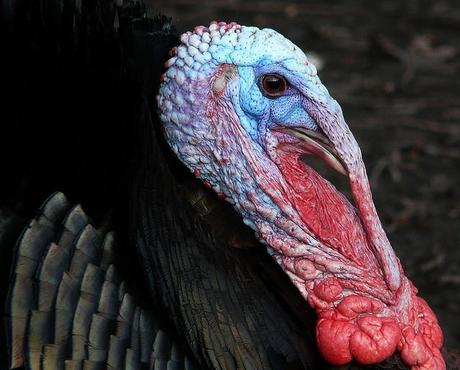
Male Turkey displaying coloration of 
his head and waddles
Turkeys in particular are very interesting gamebirds if you've seen them before. I've seen them myself on a few occasions, and they look and act like very proud animals. The males even have a behavior called "strutting" where they walk around displaying to both females and other males while dragging their wings, puffing up their tail and chest feathers, and pulling in their head. During this behavior, males have been known to change the color of their head based on how they're feeling, similar to what cassowaries and chameleons do, with blue heads signaling excitement, and red heads signaling aggression. They can also engorge the skin and waddles around their head with blood, causing them to swell up almost to the point where the eyes and beak are concealed.

The bare, blood-filled skin and thick body feathers in males doesn't come without consequences. Some studies has shown that overheating is a problem at times, and males will often rest in the shade for hours at a time, and have been known to pant on hot days like dogs and crocodiles do. Females, with less body plumage and more plumage on the head when compared to males, don't have as much of a problem, and are free to forage for food most of the day without resting. The diet of a Turkey includes grain, leaves (including conifer needles), nuts, seeds, berries, roots and insects. They have also been observed eating small vertebrates, including frogs, lizards, and even snakes.

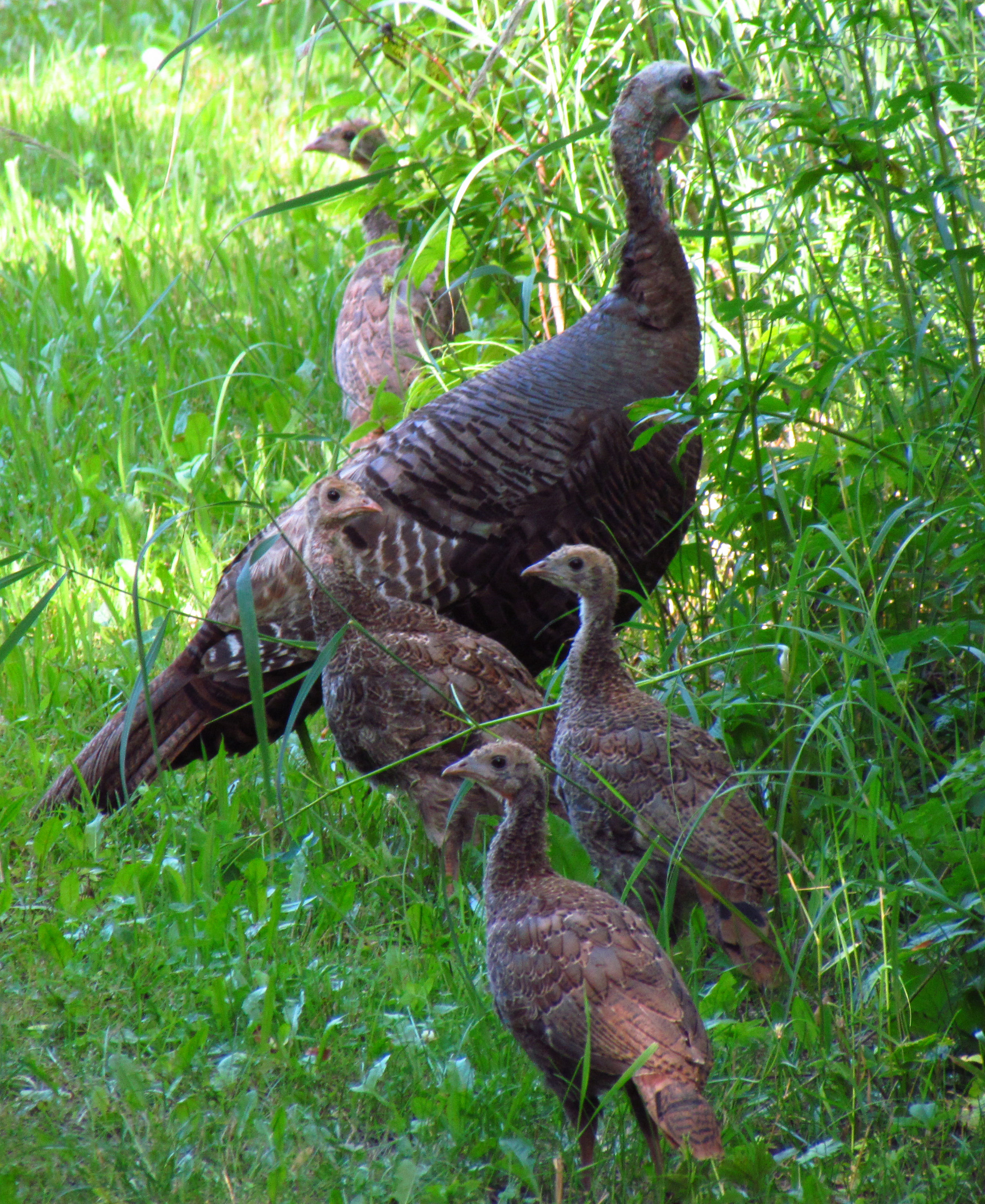
Female Turkey with Chicks

As with almost all gamebirds, males play no role in parental care, and are polygamous, mating with multiple females in a season. The female is thus left entirely responsible for taking care of the offspring, which can sometimes be up to 14 juveniles. The eggs are layed about one day apart in a shallow dirt impression, and they all hatch after about 28 days and leave the nest within their first 24 hours. The female will then watch over the young for the next 8-10 months until they are large enough to take care of themselves. If confronted by a predator, turkeys prefer to run rather than fly, using their long, athletic legs to escape danger, although if forced to they have been known to be quite agile fliers, and will sometimes roost in trees to sleep in relative safety.

Native Americans have long relied on turkeys, and they were considered a vital food source for many eastern tribes. During the first Thanksgiving, the governor of Plymouth sent out four men to catch turkeys for the big feast, and came back with enough turkeys to last them a week. However, turkeys weren't the only animals being served. Deer, geese, ducks, swans, passenger pigeon, fish, eels, shellfish, mussels, clams, and lobster were also on the menu. After the first Thanksgiving, British trading ships brought the animals back to Europe as food. They were forced to travel through Constantinople in Turkey before reaching other countries. People then associated the birds with that nation, which is where their name comes from.

Sadly, it seems that food is one of the only things Turkeys are remembered for in history, but one famous historical figure thought highly of Turkeys. Benjamin Franklin wanted the Turkey to be the national bird of the United States rather than the Bald Eagle. He believed the Turkey to be a more noble and proud bird than the Bald Eagle, as he had witnessed Bald Eagles stealing food from other smaller birds, and basically bullying them into submission (many Raptors are known do this). Many disagreed with him, however, preferring the stronger and more powerful Bald Eagle over what they viewed as the comical turkey. I'm happy with the Bald Eagle as America's national bird, but I'm also glad that Franklin looked past the non-traditional beauty of the Turkey and saw an attractive and proud creature behind that plump body.

I wish you all a Happy Thanksgiving, and hope you will respect the animal who gave their life for your meal today. As for me, I'm a vegetarian, so I'll be staying away from these birds today and hope those that did not end up on your plates will get fed just as well as I will today. What will I eat if not Turkey, you ask? Cauliflower bisque, herb-crusted tofu with mushroom gravy, chestnut sage stuffing, cranberry sauce, green bean casserole, candied yams, and delicious pumpkin pie are all on the menu tonight. Whatever is on your menu tonight, enjoy the holiday with your family and friends! And expect a lot of posts next month, since I'm going to be off for the Holidays.

Friday, November 16, 2012

OH MY GERSH! Where's RaptorX?


A Common Potoo having a panic attack.


Hey everyone, bet you were all expecting a Croc post last week. Sadly I haven't been able to get on it yet, I've been busy working on some other things, some of which I'd like to tell you all about.
The first news is that I'm writing an article for a new online magazine, called AncientPlanet Online Journal. The magazine looks nice and I''m excited that some of my articles will be appearing in it. It's every two months though and I'm trying to balance out getting info for the articles, and getting my school work done. I also have a YouTube account now if anyone is interested in talking to me on there. I might also start making videos, but I'm not sure yet, as it'll make me even more busy than I am now.

As for Crocs, it might be a while before I get to writing that post. In the meantime you might want to go over to Darren Naish's blog Tetrapod Zoology. He recently wrote a few articles on Neosuchid crocodiles, and even though I know a lot about these things, I still probably can't explain them the same way an actual scientist can.

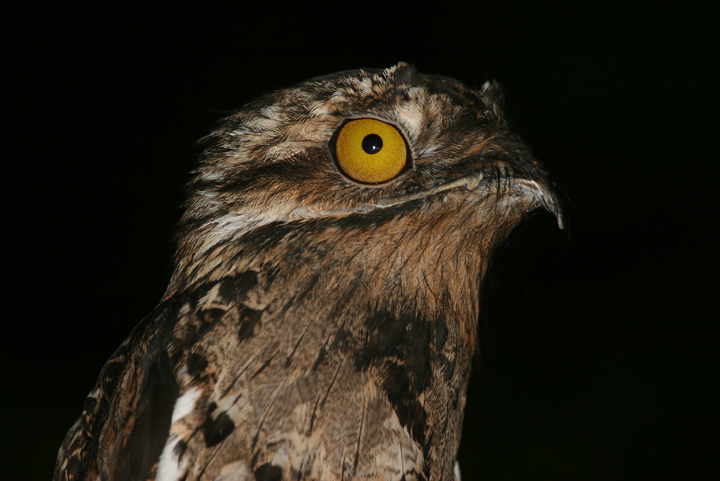
As for the meme, it's made by yours truly. The image is of a Common Potoo, which is a type of nocturnal bird from South America related to nightjars, swifts, and hummingbirds. It's an insect eater and uses its enormous mouth to gulp down moths and other insects in flight, and is famous for its amazing camouflage capabilities, being able to mimic a broken tree stump almost perfectly. It also is known for the strange call it emits, which sounds almost like a human saying "poor me, all alone." Here's some less comical images of Potoos:

Head profile of a Common Potoo. The huge mouth has tiny bristles inside which help trap any insects that get caught.
This Common Potoo was curious of the camera when this photo was taken. A Potoo's large yellow eyes are used to help them see in the dark, but give them somewhat of a bug-eyed look.
Common Potoo hiding in plain site. It might not seem wise to close its eyes when hiding from predators, but Potoos have small notches in their eyelid which allow them to see even when their eyes are closed.

Common Potoo showing its young the art of hiding. Potoos and their relatives have such good camouflage that they can fledge chicks directly on a bear tree branch, and sometimes even open ground without ever being spotted by a predator.