Tuesday, September 18, 2012

The Skulls of Sauropods and Their Behavioral Significance

A fossil replica of Camarasaurus lentus' skull.
Camarasaurus is one of the few Sauropods we have complete skulls for.
Sauropods were the most successful group of land herbivores to have ever evolved. They lived and dominated the Earth since the dinosaurs' reign began in the Triassic, straight through to the very end of the Cretaceous. They evolved into a variety of unique shapes, yet kept their ingenious body plan in check in nearly all of them. They have been found on all continents, including Antarctica, and thus some might have even braved icy climates. They were also the only land vertebrates that regularly rivaled, and in the case of Amphicoelias and (possibly) "Bruthathkayosaurus," even exceeded the maximum known size of modern day whales. However, despite their amazing sizes, shapes, and complexity, the sauropod's skull was tiny compared to the rest of the animal, barely taking up 1/200th of the total body mass, and rarely getting preserved. This has led to many problems when it comes to constructing how these animals lived, ate, and survived. Luckily, the few skulls we do have have shown that many sauropods had some unique ways of adapting to many existing problems in their native environments.

All sauropods for which we have skulls show many differences from those we've collected of their relatives/ancestors, the prosauropods. For one, the skull of prosauropods is greatly elongated, while most sauropods have skulls that were shorter. In fact, and I mentioned this in one of my other posts, the skulls of sauropods resemble the fossil hatchlings of prosauropods, suggesting that prosauropods evolved by retaining juvenile traits into adulthood (a similar theory has been put forth on how birds evolved from theropods). The openings in the sauropod's skull, known as fenastrate, are also much less organised than in prosauropods. While prosauropods had their skulls' fenestrate in line along the horizontal axis, sauropods had all the skull openings towards the top of the skull and lie in an almost "zig-zag"pattern.

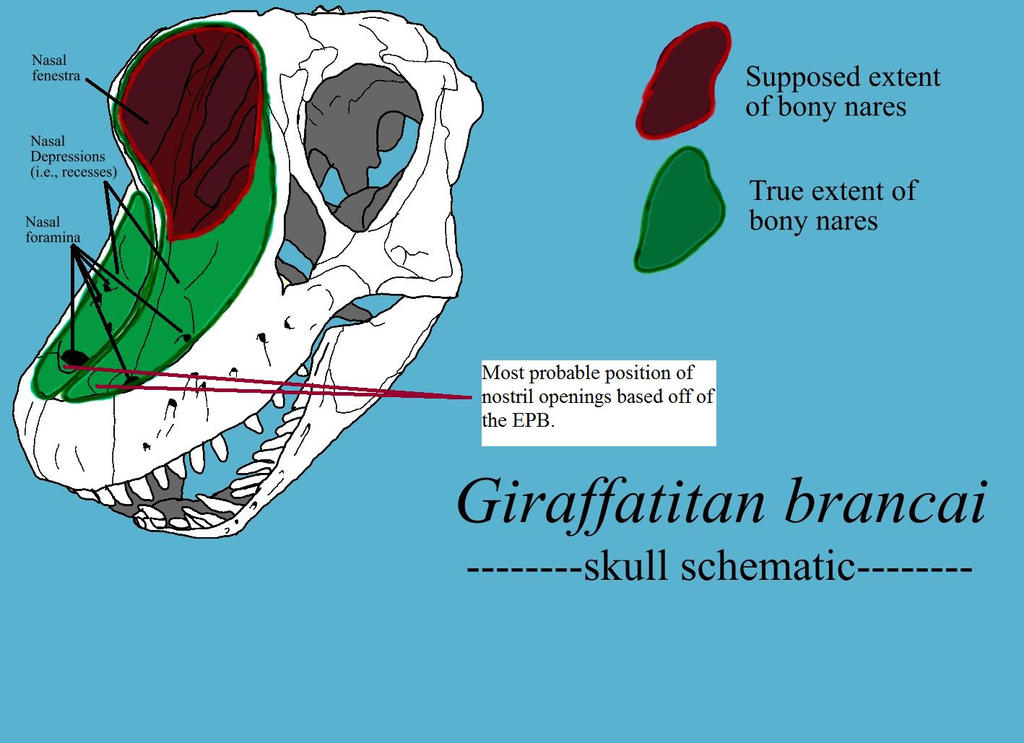
Where the nostrils of sauropods were thought to have been
as opposed to where we think they are now.
Image from palaeozoologist on Deviantart.
In many sauropods, specifically the members of the macronarian branch, the snout comes far forward of the external nares, the area that holds the nostrils. For a long time it was thought that this meant sauropods had their nostrils on top of their heads for snorkeling, as they were originally thought to be water-dwellers. In recent years, however, we have proven that sauropods indeed had their nostrils present on their snouts, and that the nostril openings were lead through a shallow depression of bone along the snout. Why did sauropods have this arangement? Well a number of theories have come forth as to why. Some have suggested it was for temperature control, others think that in some members with enlarged external nares like Giraffatitan and Camarasaurus, they could have been able to inflate skin around their nares to create a display. I, however, am fond of the idea that they might have been covered by a keratinous covering and used, along with their super-sized necks, to create low-frequency calls to communicate over long distances. Elephants, the largest land animals alive today, use low-frequency sounds to communicate over vast distances, why not sauropods?

Of course when you have a skull of an animal, one of the first things many people will examine is the teeth, and sauropods aren't lacking. We find many isolated teeth in the fossil record, and different groups of sauropods evolved different tooth designs. Primitive members of the sauropoda like Mamenchisaurus had teeth shaped almost like spoons, later diplodocoids like Apatosaurus and Diplodocus had teeth shaped almost like crayons, and macronarians like Brachiosaurus and Argentinosaurus kept the spoon-shaped teeth of earlier sauropods (well, that isn't necessarily true for the whole group, but I'll get into it further down). The teeth of sauropods were also much larger than earlier prosauropods, and took up a larger portion of the jaw. Many have less than 15 tooth positions on each side of the upper and lower jaw, basal members, however, could have up to 20, and the wonderfully weird rebbachisaurids could have dental batteries of over 30 tooth positions each with up to 8 replacement teeth underneath the present tooth!

A reconstruction of the head of a Diplodocus.
These teeth can tell us exactly what these animals were eating when you examine the amount of wear present on each tooth. When examined in this way, it seems diplodocids, like Diplodocus and Apatosaurus with their pencil-shaped teeth, had evolved to feed on trees, but were very selective, and might have preferred softer plants. In fact, a recent study using computer models found that Diplodocus' skull was best built to strip leaves right from branches. This is the first time such a method has been used on an herbivorous dinosaur, and might answer many questions as to how certain herbivores processed their food.

Not all diplodocoids likely used Diplodocus' method of feeding, however, such as the rebbachisaurid Nigersaurus, with its almost duck-like snout with close to 600 teeth all aligned across the front. Nigersaurus was likely a grazer, using its long neck to shift side to side cropping up large mouth fulls of low-growing plants. Another diplodocoid, Dicraeosaurus, had a very short neck and couldn't reach high into the trees, yet its teeth and skull suggest it was doing a similar thing as Diplodocus, perhaps to bushes instead of trees.

It also seems that many macronarians like Giraffatitan and Camarasaurus were doing something different than diplodocoids.  Macronarians and primitive sauropods, as stated above, had spoon-shaped teeth, and studies suggest they were messy eaters, and likely took in large amounts of conifers and other tough vegetation in their wide mouths. They were essentially just taking huge mouth fulls of vegitation, and when you take into account that a Giraffititan's head is about five feet long and about one and a half feet wide, they could have swallowed a small child if they wanted to! Many people forget this when studying sauropod dietary needs, and make unreasonable estimates that they might have needed to feed for 24 hours straight to gain enough food to keep themselves going. In truth, because of their huge mouths, it might have taken less time for a 30 ton Brachiosaurus to feed itself than a much smaller 5 ton elephant, which needs to sacrifice time chewing and is only able to pull up small bits of food in its trunk. Many primitive sauropods were doing similar things to macronarians, except a few might have instead fed on softer vegetation as opposed to tougher forms.

It's interesting to note, however, that a group of later Cretaceous titanosaurs, called the saltasaurids, evolved heads and body designs similar to late Jurassic diplodocids. In fact, the teeth also evolved into the crayon-shape of diplodocoids as well. Diplodocoids went extinct during the mid Cretaceous, likely being victims of a small extinction event that took place, but macronarians survived, suggesting that with diplodocoids absent, they started filling in the niches left by them and evolved similar ways of feeding.

So as you can see, sauropods seem to have made a decent living during the Mesozoic. Their skulls covered a variety of different shapes and forms in order to access their different food preferences. However, out of all different types of sauropods skulls that we have preserved, one species in particular seems to stand out. Uncovered in Argentina's Banjo de la Carpa formation in 2004, Bonitasaura salgadori has one of the oddest heads of any sauropod.

Bonitasaura's weird yet wonderful skull. Wish it was a frontal view though
since the head can be most admired from that angle. 
Known elements are in gray, reconstruction in white.
Bonitasaura's skull was extremely fragmentary when discovered, and the scientists who found the specimen at first didn't realize its significance. They did notice, however, that the skull was already a little weird; it was squared off and looked very similar to Nigersaurus' duck-like mouth, despite the fact Bonitasaura was a titanosaur, not a diplodocoid. This could be another good example of convergence between diplodocids and titanosaurs. Other than that though, the skull wasn't given much attention, and it wasn't until 2010 that paleontologists Pablo Gallina and SebastiĆ”n ApesteguĆ­a found something very interesting about the animal's lower jaw. It seemed that right behind the tooth rows, a large ridge was present that seemed to, in life, posess a keratinous beak!

The term "beak," however, should be used loosely. In truth, they were just large sheaths of keratin in the jaws that may have helped with oral processing. Still, this is a major discovery that needs more exploration, for example: Was Bonitasaura the only beaked sauropod, or did other species have beaks present and we just don't have their skulls yet? Why evolve a beak in the first place? Was the beak also present on the upper jaw, or only the lower one? Does the presence of a beak suggest that oral processing was becoming more important to sauropods towards the end of the cretaceous, possibly with angiosperms becoming more common? So far we can't answer any of these questions, and it will take much more complete specimens of this species in order to even come close to answering them.

Anyway, as always, feel free to share you're opinion and ask questions. As I said before, I also take requests for topics, since I want to tell you guys about what you want to know. The next post will be the one recommended by Mr. Gorsh, so be prepared for hadrosaurs, iguanodonts, and hypsilophodonts.

Sunday, August 5, 2012

Digging on the Net: I am a Paleontologist

Was looking on YouTube for anything interesting to watch when I happened to come across a famous song from the band "They Might Be Giants." I haven't heard from this band in years, but I heard this song being played on a shoe commercial recently (forgive me, I can't remember the brand and I'm too lazy to look it up). Here it is:


I'd rather not list the anatomical problems with the fossil animals in the video, as the list would lengthen the post to a ridiculous length..... Just a few problems include the Velociraptor's disfigured face and lack of a sickle claw, the Wooly Mammoth has bones in its trunk, Stegosaurus has peg-like, not rounded teeth, and that there is no dinosaur named Carnotaur. Either way, it's a fun video and it's not supposed to be taken seriously.

Anyway, I find it to be rather catchy, and I thought it would be something fun to share with any younger readers and maybe some older ones too that are interested in this kind of stuff. I will probably be humming this for the next few days while I type my next post, it's gotten into my brain. By the way, I've decided, my next post will probably be about Sauropod skulls and maybe feeding habits of some other herbivorous dinosaur.

Monday, July 30, 2012

Our Tiny Garden Terrors

A few weeks ago, my family and I woke up on what we thought would be a normal day. My mom was making breakfast, I was reading a book, my dad was trimming our trees, and my sister was playing with her dog. After a little while, my dad came inside and told us to come outside to see something. I thought it was going to be something uninteresting at first, but I went along anyway. He took us to the big Ficus tree in our front yard, and what do you know, we found out we had some guests.


We were very surprised! The little teacup nest was right among the branches carefully concealed. The little protruding beaks from the nest told us we were dealing with Hummingbirds, or members of the Trochilidae family, if you want to be scientific about it. We've had Mourning Doves and Sparrows nest in the eaves of our house before, but Hummingbirds were a first for us.

The nest they were in was woven out of many different kinds of materials. The mother probably wove it out of spiderwebs, animal hair, lichen, and other materials. The two hatchings probably came into the world a few days apart, as suggested by the size difference between the two (one was definitely bigger than the other). They were hidden underneath the branches and surrounded by leaves on all sides, making it hard for any predators to get to them.  The mother did very well protecting them.

Speaking of the mother, my dad said he had seen a hummingbird flying around the tree a few days earlier, and said it had a brown stomach and a green back. Not much to go by, but we thought it was an Anna's Hummingbird (Calypte anna), as they're common where I live and we'd seen them before feeding on our neighbor's Hummingbird feeder.

My mom, however, was mostly worried about their safety. While trimming the trees, my dad had accidentally exposed a bit of the nest from underneath, which could've made them a potential target for predators. The Mourning Doves we had before had their babies eaten by a small gang of crows, and she was also worried since our new neighbor's cat kept on coming into our driveway. In fact, in some places pet cats are decimating to local bird species, but that's a different story altogether.

I was also concerned, so we decided to help the mother out and watch the youngsters grow, which was very fast. We swear that on some days the hatchlings almost doubled in size within 24 hours, and  after a few days they were getting too big for the nest.


This was when they started to look more like Anna's Hummingbirds. Hummingbirds are fed on a mixture of nectar from different kinds of flowers and crushed up insects (since nectar alone doesn't provide enough protein for growth). We hadn't seen the mother very much.  We caught a few glimpses of her flying by, but we never saw her on or near the nest. However, by the health and growth rate of the hatchlings, we knew they were being fed well, probably when we weren't looking. Smart mom, she didn't want to give them away.

In most bird species, however, both the mother and father would help raise offspring. Hummingbirds are different in that only the mom takes care of the young. This is likely due to both the father's interest in mating with other Hummingbirds and the fact that Hummingbirds are more territorial than other birds.

WHAT? Cute little innocent birds are territorial? That doesn't sound right...

I normally get that remark when talking to people about hummingbirds, as you typically see them traveling around the countryside, flitting from garden to garden.  Hummingbirds are very territorial, especially the brightly colored males (as you can see below). A few species are less territorial than others, but many won't tolerate one another and will lay claim to areas of land. Sometimes up to 30 houses and gardens can be a single male's territory, and when you look at these animal's diets, it's easy to see why.
Male Anna's Hummingbird
Female Anna's Hummingbird

Nectar is very precious to Hummingbirds, and their high energy diet is the only thing that allows them to do what no other bird can: hover, and fly backwards. This is because Hummingbirds are the only birds able to flap their wings in a figure 8, and they flap in that pattern more then 80 times per second, both of which allows for more control in flight. Only Hummingbirds can access this mode of flight because of the energy provided from nectar. Without nectar, they won't have enough energy to fly, and if they can't fly, they will die. That's why their their food is worth fighting for, and why they create territories to protect it. If you have ever seen two Hummingbirds at the same feeder, they'll normally fight over it, making loud noises, dive bombing each other, and even clawing each other if it goes on too long.

Our baby birds were likely to become powerful garden terrorists in the future, that is, if they'd survive past fledgling, which is the time they are at their most vulnerable. One day, we came outside to see that one of our little birds was starting to exit the nest (sorry I don't have a pic). My sister and mom were panicking that it might fall, but it made it back in rather easily. We came back later and found that the two hatchlings were gone. My sister was sad that we couldn't find them, and we were somewhat worried that, since they vanished, they might have been eaten by the neighbor's cat.

Later that day, however, when I was preparing for dinner I heard a loud metallic chirp outside my window where the Ficus tree grows. It was loud and sounded like metal scraping against metal. My sister said she had been hearing it all day, and thought it was my Dad's rock tumbler at work (he's always up to something). He then came in and told us he had finished tumbling his stones yesterday. We were confused for awhile about the source of the sound, but when I looked out the window, voila!, there one was of the youngsters.


The youngster was perched on a branch outside the window, looking in at us. We watched him ruffle his feathers up a few times when we saw the mother come down to feed him (I don't have any pictures sadly). Before she fed it, however, the youngster made a loud metallic noise that sounded like scratching metal. Two mysteries solved.

It turns, and I only learned this later, baby Anna's Hummingbirds are unique in the fact that they don't chirp while in the nest to ask for food. This is thought to be a protective behavior to not reveal the location of the nest when the young are vulnerable. However, when the young leave the nest to learn how to fly, as our baby did, they begin chirping so the mother can locate them, as they aren't yet accomplished fliers, nor can they feed themselves. It's a neat survival trick, and I'm surprised it's unique to Anna's.

We went outside later to find the other one in another part of the Ficus tree. Both were safe, and the mom was hovering nearby. Since it was very windy that night, my sister was worried the two could be blown out of the tree. Luckily the next morning, although we couldn't find them very easily, we could hear them chirping just fine.

It was around the time when I was writing my Sciurumimus post when we found them again, this time perched outside my bedroom window being fed and given flying lessons by their mom.


The two were staring in at me while I was writing the post. We were happy to see them both together again, something we hadn't seen since they were in the nest, but it got even better. One time, the mother joined the two in a little bit of family bonding:


The two stayed up their for 2 days, but on the third, we had seen that they had moved to the telephone lines along our street, venturing back to the Ficus tree only occasionally. They obviously flew there, but all we ever saw in the air was their mother, and a few sparrows near our neighbor's bird feeder. That, however, was the last we saw of them. We haven't seen the family since, and it's likely that they moved on to bigger gardens and greener bushes for the young to start families of their own. I have to admit I'm sad that I probably won't see them again, or even know if they are still alive, but there is hope. Apparently, some hummingbirds like to use the same nesting tree year after year, so I'm hoping to see another brood in the future.
___________________________________________________________________________

So there you have it... my summer surprise. Anything interesting happen to you? Feel free to share in the coments below. My next post is hopefully going to be on Mesozoic Plants, as I've been reading an article about some new research into it. Either that or it's going to be on the feeding adaptations and skulls of Sauropod dinosaur. After that, I'm hoping that I'll be able to publish a post I've had a request to write a for awhile by Mr. Gorsh (just so he knows, I've been working on it). I haven't had the proper notes and guides to help me out with it until now.

Untill next time, stay sharp!

Tuesday, July 3, 2012

Otto, the baby feathered Megalosaur

An image of Otto's beautifully preserved skeleton. It's no wonder that he's considered the most well-preserved theropod in Europe.

If any of you have been reading any of the news articles from yesterday, you will be excited to find that a new dinosaur discovery has finally been announced! One that the scientific community has been waiting for years and years to find. The announcement of the new theropod species Sciurumimus albersdoerferi. You have probably actually seen him before, for about a year now images of this little fella have been seen all over the Internet.

Before he was scientifically described though, the researchers studying him simply called him Otto. Otto was uncovered in the Solnhofen Formation a few years back (the same place we found Archeopteryx and Compsognathus), and was sold to a private collector. However, this collector realized the importance of this little fella, and happily allowed Otto to be studied by scientists (I guess all collectors aren't bad).

Otto is officially the most well preserved theropod fossil yet found in Europe, being over 98% complete, something scientists would normally dream about finding. In fact, a close examination of Otto under UV light has shown that he had feathers, and quite surprisingly, a long bushy tail like a squirrel, hence his genus name meaning "squirrel mimic." Many have been pleased by Otto's discovery, not just because he is so well preserved, but because he rewrites the history books on Dinosaur feather evolution. Unlike all other feathered dinosaurs found so far, a scientific analysis suggests that Otto isn't a member of the Celurosauria, the branch of theropods that all feathered dinosaurs have been found on. He is instead thought to be part of an older branch of theropods, the Megalosaurs.
A close-up of Otto's curious little skull.
I've been wondering whether or not the bone beneath his jaw is actually part of him or another animal, such as a "last meal." If anyone has an answer I would be grateful if you could tell me.

Megalosaurs were mostly 20-25 ft predatory Tenurans that lived during the Jurassic, and apparently died out due to competition with more successful theropods like members of the Carnosauria. However, during their time on earth they were very powerful predators, and one species called Torvosaurus apparently reached and even exceeded the size of some specimens of T-rex.

Now Otto isn't an adult megalosaur (if he was, he'd definitely be the smallest one we know of), he is only a baby, possibly only a few hours out of the egg and roughly 28 inches from nose to tail, and on par with Scipionyx for the youngest theropod we know of, but he is monumental in the fact he is the most well preserved megalosaur ever found. Almost all megalosaurs that have been found are known from only fragmentary remains, which is one reason why Otto is such a monumental find. We have already learned so much from his remains, including finally solving the riddle of how many fingers megalosaurs had, and roughly how long the tail was.

But the monumental find is, of course, the feathers. Otto provides the first piece of evidence of feathers on another theropod branch outside the coelurosaurs. (If, of course, Concaventator's bumps aren't quill knobs and Yutyrannus is 100% a tyrannosauroid) Being a megalosaur, the origins of feathers in theropods would have to be pushed back to the base of the Tenurans at least, and with fluffy ornithischians like Tianyulong and Psittacosaurus, it really does seem like all dinosaurs have a fluffy ancestry. So we may need to start portraying our more primitive giant theropods like Allosaurus, Giganotosaurus, and more primitive forms like Dilophosaurus and Crylophosaurus with fluffy coats.

Before the discovery of Otto, Juravenator was
the most well preserved Theropod in Europe,
 and is considered a Coelurosaur.
I've gotten a lot of sass with this subject, as I've heard a number of people complain that we are lacking the evidence of making such assumptions. However, absence of evidence is not evidence of absence. We don't have any skin impressions of primitive and basal dinosaurs from the early Jurassic and Triassic, and of what we do have does seem to suggest the idea of feathers. One fossil of a Dilophosaurus(?) that was sitting down in a resting position have shown evidence of fibers around the stomach, legs, and pelvice, suggesting possible filament-like feathers. However, this impression has been greatly criticized, and many think that these traces might simply be plant debris that was dragged along by the dinosaur. The discovery of Otto might help people lean towards the fluffy side of things.


So with the discovery of Sciurumimus we're going to have to start drawing some fuzzy Allosaurus, and I do hope that in the new Jurassic Park expected to come out in 2015 we'll have some fuzzy dinosaurs. The fossil record right now is screaming at us "DINOSAURS ARE FLUFFY, STOP ANIMATING NAKED T-REXES!" that we should really start listening. I've also gotten some sass as above with all dinosaur having a feathers about how if we start animating our dinosaur as fuzzy, they'll become less scary and less apealing to audiences and the general public in things like horror films. Well, I swear that if you were being attacked by a lion, you wouldn't be standing there thinking "Awwwww, it's so fluffy!"
____________________________________________________________________________

So there you have it, if anybody has any more questions feel free to ask me. I'm going to make a post soon about some Dinosaur decendents I found in the tree in front of my house, and one of which was watching me through my window as I typed this article. I'm not giving away what they are, but I'll tell you they're very cute, and very fast.

Monday, May 28, 2012

Atlasaurus imelakei: The Sauropod on Stilts

A small herd of Atlasaurus. Just look at those long legs, but why the short neck? 

OK, there are some pretty weird sauropods out there. Amargasaurus cazaui seemed to have had a pair of spikes going down its neck, Nigersaurus taqueti had a duck-like snout and a constant supply of teeth in its jaws, and nobody can forget the armored monster Agustinia ligabuei that gave stegosaurs and ankylosaurs a run for their money. But I think that one sauropod should be added to this list. One that you've all probably heard of somewhere, but never got the chance to learn about; Atlasaurus imelakei.

Atlasaurus was named after two things, the Atlas mountains in Morocco where it was found, and its large body size, which was refers to the Greek Titan Atlas who holds up the world on his shoulders. It lived during the Mid-Jurassic and was a member of the Macronarians, a group of sauropods that included Brachiosaurus, Camarasaurus, and all the later Titanosaurs, however, where Atlasaurus fits in this group is uncertain, but many think it's a close relative of the Brachiosaurs.

Atlasaurus is known from a near-complete skeleton, only missing part of the skull and tail. It seems to have been about 50 feet long, which is mid-sized for a sauropod, but larger than nearly any other type of dinosaur. However, when scientists first found the leg bones, they estimated an animal  much bigger, around the 70 foot range. In fact, when the full specimen was unearthed, scientists were baffled to find that Atlasaurus had the longest leg-to-body ratio of any sauropod. They had discovered a sauropod on stilts!

The arms of Atlasaurus alone were about 12 feet tall, and the full leg was almost 15 feet tall. In fact,  the legs would've probably fit nicely onto a 70 foot Brachiosaurus, despite being three times more massive! Like Brachiosaurus legs, the humerus was nearly as long as the femur, and the other bones in the legs were also quite tall, pushing the shoulder level up much higher than the level of the hips. This gave both Atlasaurus and Brachiosaurus good height while feeding, and made them good tree-top feeders. You'd probably think that with Atlasaurus' longer legs though, it would give it a higher reach than other sauropods in it's size range. Well the interesting thing is, Atlasaurus has lost a lot of it's neck.

Along with having increasingly long legs, Atlasaurus seems to have lost much of the giraffe-like neck of other sauropods. The neck is considerably long compared to most animals but compared to giraffes and other sauropods, Atlasaurus was one of the shortest-necked sauropods, only beaten by Brachytrachelopan and some other short-necked dicraeosaurids. This makes Atlasaurus unique in the fact that it evolved longer legs to increase feeding height, while basically every other sauropod yet discovered simply evolved a longer neck to increase feeding height. However, it isn't so hard to imagine why most sauropods took the easy way up.

An interesting thing to note is that the combination of such long legs and such a short neck suggests that Atlasaurus was unable to reach the ground to feed or drink by simply using the "giraffe posture" some sauropods are thought to have exploited. The only way it could simply bend down to drink is by either submerging itself up to it's knees, or by bending it's elbow at a near 55° angle, spreading the legs apart into an old ceratopsian-like pose, and shifting its center of mass towards the front of the body. When you factor in that this animal is close to 14 tons, it becomes clear that this is an incredibly difficult maneuver to pull off. 

This long legs and short neck combination seems like more of a handicap than an advantage. In fact, even I have trouble trying to find out exactly what evolutionary pressure caused Atlasaurus to evolve such features either. Just finding an explanation for the long legs alone proves extremely difficult, but I've come up with a few ideas, although none seem legit.

My first idea was that, due to the handicap that Atlasaurus couldn't drink easily without being submerged suggests to me that it may be semi-aquatic, using it's long legs to sift through marshes and wetlands and walk along river bottoms. I quickly rejected that idea after reviewing the anatomy again, which seems even worse at such behavior than most other sauropods. And although evidence shows that these animals lived along coastlines, no marshes were present and the climate was mostly dry and arid. 

Perhaps the long legs were for increased speed. The long legs of a giraffe can propel adults across land at 31mph, which helps them escape from predators. However, a quick comparison to the legs of a giraffe and Atlasaurus certainly shows that these animals weren't runners, and the difference in length of the front and hind limbs would also hinder speed because the front legs would surpass the stride of the rear ones. Another interesting idea I had is that the legs could help keep their bellies from getting injured from thorny plants while moving through heavy brush. But in my opinion, it is hard to imagine what kind of spiky plants would cause such discomfort as to change their whole anatomy. And as I said before, fossil evidence suggest that these animals lived along semi-arid coastlines, not dense forests with spiky plants.

At the moment we have no idea as to why Atlasaurus evolved as it did, and it is certainly one of those oddballs on the dinosaur family tree that we may never have the answer too. So why do you think Atlasaurus evolved its long legs and shortened its neck? I'd definitely love to hear other people's opinions on why this creature evolved.

Saturday, May 12, 2012

What little details can tell you.

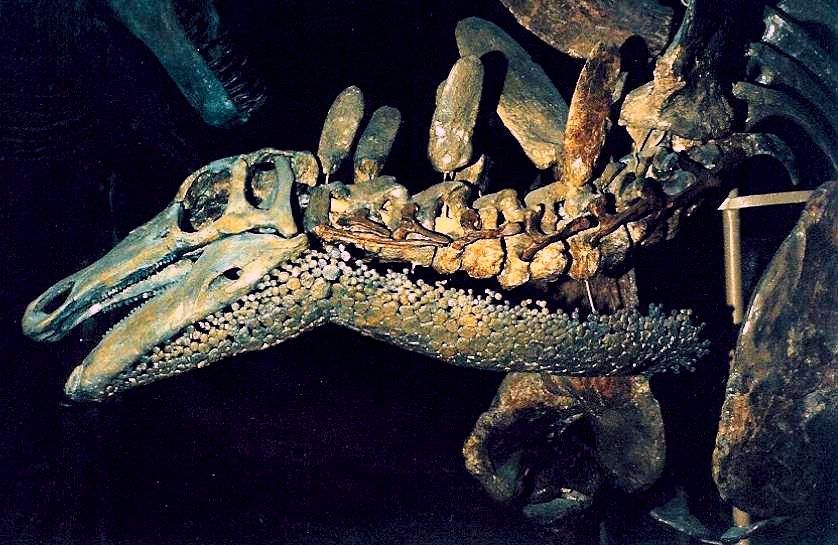
Ahhh, Stegosaurus neck armor, all the things you can tell us....

Being the Paleontologist-in-training that I am, I'm very interested in how dinosaurs behaved and interacted with one another on a daily basis. I want to know how they caught their prey, escaped from predators, and what they were doing that helped them survive for however long they did, and much of a dinosaur's anatomy can tell you exactly that. I've developed a little talent where I can look at any part of a dinosaur's anatomy and come up with a number of ideas for the purpose of the limb, neck, tail, or skull. Then it can give me some ideas on how the animal might have lived.

For example, Stegosaurus is famous for its double row of back plates on its back, but many people don't know that it actually had a dense layer of pebbly armor on the underside of its neck. The most obvious idea is that the neck armor was a defence for the neck against theropods, but I can think of many more functions. Another is that the armor could have been used as a display, similar to what many now think the plate's function was. Some pebbly osteoderms seen in things like iguanas and other lizards are used as a form of display, and large scales seen around the head region in both lizards and birds are used for show.

Stegosaurus also notably lived in an environment filled with cycads, which produce large cones filled with seeds that are very nutritious. However, the cone is protected by the large spiny leaves surrounding the center of the plant, and could cause injury to animals trying to reach into it. So maybe the neck armor was used to help Stegosaurus reach into the cycads and feed on the seeds. Maybe Stegosaurus was a specialist cycad eater?!

Entire debates can spur up from little ideas like this, and can help explain many unexplained phenomena in the fossil record. Stegosaurs became less common by the beginning of the Cretaceous, but flowering plants also started to take over by this time as well. The evolution of flowering plants also coincided with the diversification of numerous groups of herbivores, among them the ornithopods and ankylosaurs, which would've caused competition with the Stegosaurs. Angiosperms also began out-competing cycads and forcing them to retreat to the tropics, so perhaps the cycad-eating stegosaurs went extinct as the cycads sterted to disapear. It could have happened.

(I literally came up with that theory within the last 20 minutes before writing this, but looking over it multiple times I can believe it. I'll probably look more into the idea, see if anyone else has suggested anything like it....)

I can do the same thing with other dinosaurs, take this for example: Small ornithopods like Hypsilophodon have long toes. It's true, Hypsilophodon and its relatives do have rather long toes. At first some thought this meant they may have been tree-climbers, a lot like tree kangaroos from Australia and New Guinea, which also have long toes. However, many now find this unlikely, since many of the proportions of the feet are not like those of tree-climbing animals, and are typical of ground-dwelling ones. They also had stiffened tails, not the flexible tails of most tree-dwelling animals, and suggest that they were fast runners. So why did they have long toes? 

Looking at modern animals, many ground-dwelling animals that have long toes live on marshy and uneven ground, since it gives them more grip when moving and helps prevent them from sinking in mud. Many of these species are also found in deposits that were marshy and wet at the time, and it seems likely to think that they were living in these environments. Even if many people agree that it had a certain function, opinions on how it was used may still differ. Camels, for example, also have long toes and broad feet to gain the same effect when moving across sand dunes. So maybe they were desert dwellers? (I find this unlikely) Some small animals also use long toes to help distribute weight while moving over snow, very similar to what snowshoes tend to do. Some small ornithopods like Leaellynasaura would've encountered snow during parts of the year, so perhaps their long toes helped them with moving across this kind of terrain.

As you can see, you can tell a bunch of stuff by just looking at a dinosaur's foot, tail, or skull, and little details like what I listed before can tell you all kinds of things about how it survived, interacted, and even went extinct. That's why every bone counts when talking about dinosaurs. So, I've decided that the next few posts I make are going to be about all kinds of interesting dinosaurs. I'm also thinking about making some topics about different dinosaur lifestyles, such as semi-aquatic ones, and different behaviors the would've exploited. Many people only think of spinosaurs when talking about semi-aquatic dinosaurs, but trust me, I've found many more examples than those fish-eating theropods.

So yea, you could say this is my make-up for the previous month of absence, but I was planing on doing this before then anyways. So, as always, I'll take requests for dinosaurs and as many ideas for topics as wanted.

RaptorX

Sunday, May 6, 2012

Predators or Scavengers: Those Puny Little Arms

Don't worry T-Rex, I hate them too.
Tyrannosaurs had huge heads, terrifying jaws, and extremely powerful bodies, so it doesn't really make any sense that these predators have those puny little two-fingered arms now does it? Some have taken this as evidence of a loss of predatory lifestyle in the tyrannosaurid group, while many others find the small arms as being lost to compensate the enlarged jaws. Both, however, have their problems, and that's what my new Predator vs Scavenger topic is about! We will be reviewing the structure, musculature, evolution, ontogeny, and all the known possibilities for the strange arms of the tyrannosaurids to attempt and find out why tyrannosaurids evolved their tiny little appendages.
___________________________________________________________________________________

Biomechanics of the Tyrant's Tiny Limbs
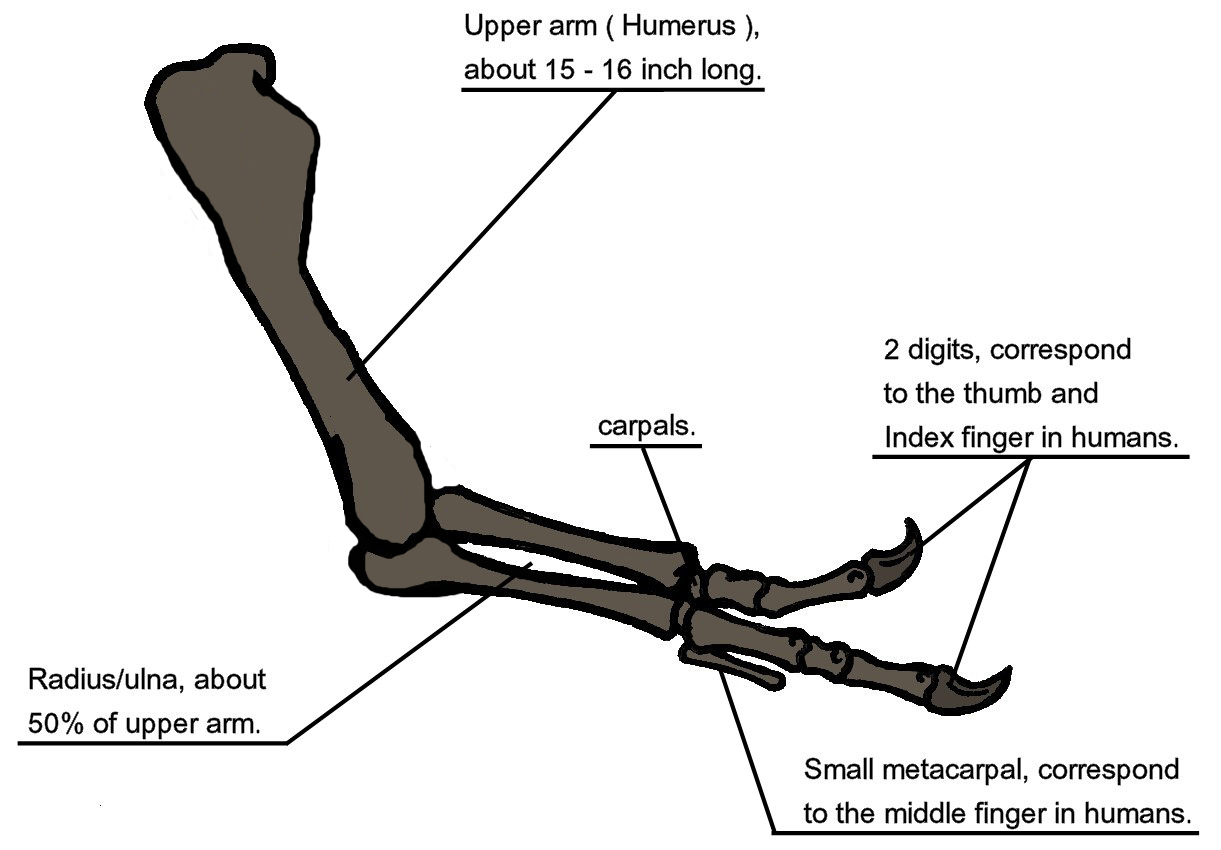
When Tyrannosaurus rex was first discovered in in the first few years of the 1900's, only the humerus (upper arm bone) was recovered, and the first mounted skeleton of T-rex in 1915 portrayed it with three fingers like those of Allosaurus and most other theropods. However, a year earlier the forelimb of Gorgosaurus was described and showed the typical two fingered hands characteristic of tyrannosaurids. It wasn't until 1989 that we had our first complete T-rex forelimbs, and proved just how short and tiny these arms were.

The arms were small relative to the animal's body size, only about as long as a average human's. The humerus of T-rex was roughly 15 - 16 inches long, and was made up of extremely thick cortical bone (a type of bone with very little openings and high density), making it able to withstand heavy loads. The radius and ulna (lower arm bones) were both only about 8 inches long, and weren't quite a strong as the humerus. The hands were made up of the two small carpal bones, one reduced metacarpal that represents the lost third finger, and two functional digits.

It's true these arms were tiny, but they certainly weren't vestigial or useless. Like I said, the arms were made up of thick bone, and was built to withstand strong forces. Their are also areas on the arms and the long shoulder blades for large muscle attachments. In fact the biceps of a full-grown Tyrannosaurus was capable of lifting over 400 pounds, not even counting the four other kinds of muscle present in the arm.

Even though the arm was particularly strong, it had a reduced range of motion, and was only capable of allowing 40 degrees of motion at the shoulder and 45 degrees at the elbow. Compared to humans this is very small range, but even other theropods such as carcharadontosaurids, allosaurids, and especially members of the maniraptora all have a range that greatly exceeds that of the tyrannosaurids.
___________________________________________________________________________________

Evolution and Ontogeny of the Puny Little Arms

The tyrannosaurs didn't always have their tiny arms though, early tyrannosaurs like Guanlong, Dilong, and the (really) recently discovered Yutyrannus all have arms that are either in the typical size range of most other theropods, or actually longer. It was only the later, larger tyrannosaurs that evolved their abnormally small forelimbs, though exactly when these tiny arms evolved in the first place remains unknown.

In 2010 the mystery was thought to have been solved by the discovery of Raptorex, which was thought to be a small tyrannosaur from the early cretaceous that had already evolved the two-fingered limbs. However, it was later studies on the specimen showed that Raptorex wasn't actually from the early cretaceous, but actually dated to the masstrichian stage of the late cretaceous. Not just that, but the remains are strikingly similar to known Tarbosaurus juveniles, and the specimen itself is already known to be immature. Many now consider Raptorex to be a nomen dubuim, and most likely represents a juvenile Tarbosaurus. Thus, the mystery as to where these stubby little arms emerged remains anonymous.

At the moment, the transitional morph is still yet to be found, but based on my knowledge of these tyrants, I personally believe the small arms probably evolved about 85 mya in either North America or Asia. Both places have early tyrannosaurids present, in Asia it was Alectrosaurus and in North America it was Appalachiosaurus. Sadly the front limbs of both species are unknown, so whether or not they had short arms of animals like Tyrannosaurus or long arms of creatures like Yutyrannus is still a mystery. All the tyrannosaurids from 80 mya onwards had puny little two- fingered digits.

However, it does seem that at least one tyrannosaurid "bucked the trend" a bit when it came to the puny arms. Daspletosaurus torosus had the longest arms of any tyrannosaurid known, which were about twice as long as a tyrannosaurid of similar size. This is especially strange since Daspletosaurus is also known to have had really short legs, the shortest in the family, while most other tyrannosaurs had rather long legs for theropods. (I have a theory as to why this might have happened in Daspletosaurus, but I will talk about it farther down the post)

One of the most interesting things about tyrannosaurid arms though are the changes they experience as the animal grows. Young tyrannosaurs, and especially members of Tyrannosaurus itself, tend to have very long arms and claws compared to their parents; the size of a juvenile's arm was about the same length as the adult's arm, despite being 10 - 15 times less massive. Not just that, the arms of the juveniles have the same proportions as some allosaurids, and they aren't just long, but very strong and much more useful for grasping.

Just try comparing the tiny stubs of Sue...
...to the longer arms of Jane.
The change in the arm lengths might reflect behavioral changes as tyrannosaurs grew, and also suggests that juveniles used their arms more than adults did. I have even heard some suggestions that the adult's tiny arms were there simply because of their juvenile stage. Although this idea may have some truth to it, I still think another theory for their function may be more likely.
___________________________________________________________________________________
  
The Function

So after that little overview on the forelimbs, let's try and see which of these theories is most logical:

Head over Hands:
Why does Rex have three fingers?

Of course, the first theory is that the arms were simply useless appendage that were lost as the skull grew to it's enormous size to keep it in balance. It's an interesting idea, but abelisaurids have tiny arms, even smaller than that tyrannosaurids' stumps, yet the skulls of these animals are actually smaller compared to body size than many large theropods. At the polar opposite, some carcharodontosaurids have skulls that are actually larger than most tyrannosaurs of similar size, and heads just as heavy. Yet they have typical three-fingered, long arms of most large theropods. With this logic, why didn't they lose their arms?

It's also interesting to note that theropod arms aren't very heavy in the first place, and shouldn't cause too much of a weight problem. So this theory doesn't really hold up very well. However, even if the head wasn't responsible for such a thing, it could be behavioral reasons that caused the arms to become reduced. The head was massive and built for crushing bone, which could have made the arms redundant simply because they didn't have a use anymore. This could also explain the abelisaurid arms, as the skulls of these animals were built for gripping, so the arms probably hadn't much use either.

However, as I explained earlier, even though they were small, the arms were heavily constructed and powerfully muscled. So no matter what people say, they were probably used for something. I will note, however, that their are many tyrannosaur specimens have been found with broken front limbs, injuries caused during life. A few specimens even show limbs that were nearly or completely torn off, but had healed over. The fact that we find these specimens survived losing these limbs suggests that these animals could go without using their tiny arms for extended periods of time, if not at all.

All for Love:

Uhhhh, more three-fingered Rexes....

Some interesting theories suggest that the arms might have had some kind of mating purpose, either for grasping mates, as display organs (such behavior is seen in ostriches), or for keeping your mate happy by "scratching their itch."

The idea that they were used for grasping mates was first proposed by Henry Osborn (the one who described T-rex) in 1905, and has become one of the most popular theories for their use. I have to admit that I find much of the evidence stacking in this theory's favor.  Being so big means that you have a harder time trying to mate. Tyrannosaurs were very large animals that primarily used their heads and jaws to secure a meal, thus the arms were mostly lost, but still kept to help right themselves when mounting a female.

I mentioned earlier that Daspletosaurus had the longest arms of any tyrannosaurid, but the shortest legs. This is consistent with the copulation theory. Since Daspletosaurus was so close to the ground, it would've had a much harder time grasping a mate during copulation. Thus, as the legs got shorter and the animal got closer to the ground, longer arms were probably favored to help with gripping onto mates.

The other two theories are also somewhat believable, but they are based on ideas with no evidence for. Nobody can test whether or not a female Gorgosaurus thought a male Gorgosaurus looked "sexier" with bright colorful armpits. Neither do we know weather or not Tarbosaurus really scratched their mates to make them feel better, or weather or not they were even social enough to exploit such behavior. They're all very interesting ideas, but they're nothing more; just ideas.

Prehistoric Forks:

Ok, I will point out the numerous fingers, but I'm more worried about the feet...

A rather odd theory that I've come across many times over the years is the idea that the tiny arms were used like a carving fork; holding onto the sides of a prey item as the jaws dispatched it and tore it apart. Other than the fact the arms had two sharp claws on them, their is basically nothing that suggests such a behavior, and the arm's design is not really built for it anyways.

For one, tyrannosaurid arms were very small and had a limited range of motion. This is the exact opposite of an animal that uses it's arms to grapple onto prey, such as the allosaurids and dromeosaurids, which have arms that are longer and have a large range of motion to reach out and pull another animal in towards it. They're built more like a carving fork, for holding onto something at close range that doesn't struggle, which brings more evidence to the copulation theory, as a mate is less likely to pull away than a prey item.

Another interesting point is the arm's overall length. They were so small that if a tyrannosaur was to grab onto a prey item, the animal would be literally pressed right up against the chest of the predator. Wouldn't you thing it'd be rather hard for something like a T-rex to dispatch a dinosaur that would basically be underneath it's body? Try eating something tied to your chest with just your mouth....

Also, note that evidence from the last few years have shown that tyrannosaurid hands faced inwards like all dinosaurs, not straight down like they were portrayed for so many years. Why do I point this out? Well one thing that you have to remember is that tyrannosaurs were often the largest animals in their local ecosystems. So if they were to try to catch something with their arms, wouldn't you expect the fingers to point downwards towards the smaller prey item? Not inwards which would've made it harder to hold on and grip.

Getting Up in the Morning:

Hey, it's a picture of me in the morning...

This is another rather interesting idea, that the arms were braces the were used to right the animal as it got up. This was first proposed in 1970 by Barney Newman, and became very popular at the time. During such activity, the forelimbs of the animal would have been extended in an action somewhat reminiscent of a push-up. However, with recent biomechanical analyses, such behavior seems impossible for a tyrannosaur to preform.

For one, as I mentioned above, the fingers weren't pointing downwards, they faced inwards. The shoulder joints were also too inflexible to allow the hand to face downwards, and prohibited a holding use for the claws to push on. This means that for the animal to be capable of pushing itself up, it would needed to do so with the sides of it's arms, and with very little surface area to actually push. 

Even so, it doesn't seem too hard for a tyrannosaur to actually get up without the aid of it's arms. All you need to do is have your legs right underneath your center of mass, then it's just a mater of lifting yourself up. Think about modern day bipedal animals, like ostriches, which get up just fine without the aid of arms. Us humans can also easily get up from a crouching position without our arms. Unlike ostriches or humans though, Tyrannosaurs could have also used their tails to help right themselves through counterbalancing.

___________________________________________________________________________________

Conclusions

In my opinion, the only practical theory put forth so far is, ironically, the first to be proposed: copulation. It works well with what we know about large bodied animals, and these extinct tyrants seem to be no different. Although the arms may have been used for more than just copulation, I think that that was the only reason why they were retained for the last 20 million years of the Cretaceous. I find it interesting to think about what these animals would look like if they had survived past the extinction. Perhaps the giant Tyrannosaurs would keep their arms, but if smaller species evolved they may have lost them without any of the size restrictions.

But now here's an interesting little thought, note I said almost nothing in the post about whether or not the tiny arms suggest Tyrannosaurs were scavengers or a predators. That's because they don't indicate either. Many animals lack arms and are very efficient predators, such as Anacondas, Sharks, and Birds of Prey. So are many active scavengers, like Vultures and Piranha (despite popular media these are actually quite timid fish). Thus, it doesn't necessarily mean anything...
___________________________________________________________________________________

P.S. Sorry it has been so long since my last update. I've been busy with a science fair project at school and was unable to be on here at all. Luckily, I finished it earlier today and am hoping to make up for lost time with a special post about what I've been working on.

RaptorX